AI-Powered Learning Explained: Faster Academic Success


More than 80 percent of American university students say video summaries help them understand course material faster. The rapid growth of AI-powered learning is reshaping how complex topics are studied, especially when traditional online videos feel overwhelming or time-consuming. Today’s academic tools can break down dense subjects and deliver concise overviews, allowing American students to turn long lectures into practical, personalized research assets with just a few clicks.
Table of Contents
- Defining AI-Powered Learning For Students
- Types Of AI Tools Transforming Education
- How AI Summarizes And Enhances Videos
- Benefits And Limitations Of AI-Based Study
- Risks, Ethics, And Academic Integrity Issues
- Using AI Responsibly For Academic Research
Key Takeaways
| Point | Details |
|---|---|
| AI-Powered Learning | Utilizes advanced technology to create personalized and adaptive learning experiences for students. |
| Types of AI Tools | Include intelligent tutoring systems and learning analytics that provide real-time support and insights for academic growth. |
| Benefits and Limitations | Offers personalized feedback but poses risks of diminished critical thinking and over-reliance on technology. |
| Ethical Considerations | Importance of maintaining academic integrity and responsible use of AI tools in research and learning processes. |
Defining AI-Powered Learning for Students
AI-powered learning represents a transformative educational approach that goes far beyond traditional study methods. At its core, this innovative strategy leverages artificial intelligence to create personalized, adaptive learning experiences tailored specifically to individual student needs. Advanced AI technologies are now enabling students to receive customized educational support that adapts in real-time to their learning pace, style, and comprehension levels.
The fundamental components of AI-powered learning include intelligent algorithms that analyze student performance, predictive learning models, and dynamic content recommendations. These systems can identify knowledge gaps, suggest targeted resources, and provide immediate feedback more effectively than traditional educational approaches. By processing vast amounts of learning data, AI tools can generate insights that help students optimize their study strategies, understand complex concepts faster, and develop more efficient learning techniques.
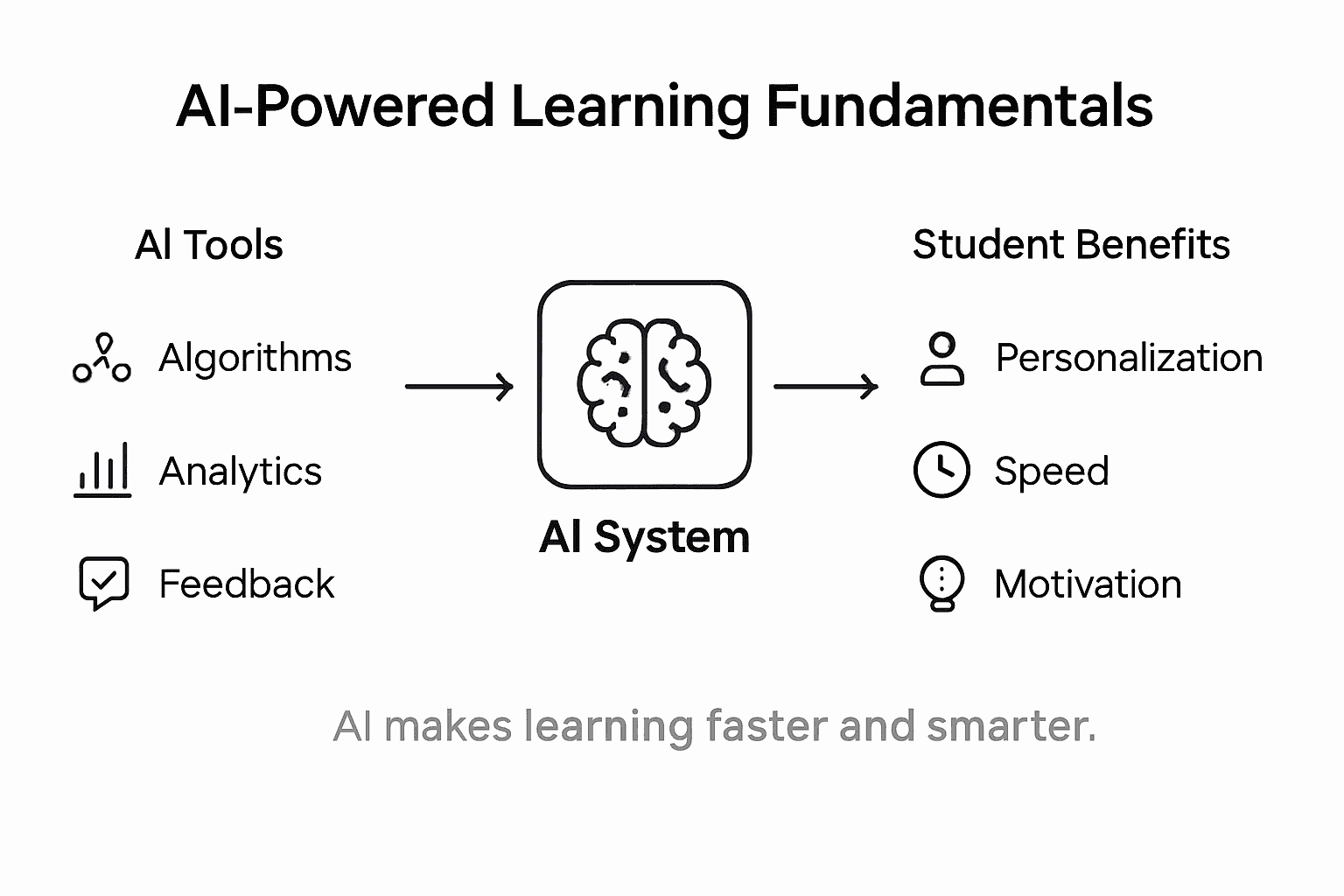
Crucial to understanding AI-powered learning is recognizing its dual nature: technological capability and student empowerment. Research demonstrates that these systems are not just about replacing traditional learning, but augmenting human potential. Students gain critical digital literacy skills, learn to interact with advanced technologies, and develop a more nuanced understanding of how artificial intelligence can support academic growth. This approach prepares learners not just for current academic challenges, but for future careers in an increasingly technology-driven world.
Pro tip: Start small by integrating one AI-powered learning tool into your study routine to understand how personalized technology can enhance your academic performance.
Types of AI Tools Transforming Education
The landscape of educational technology is rapidly evolving, with advanced AI applications revolutionizing how students learn and interact with academic content. Intelligent tutoring systems represent one of the most significant innovations, offering personalized learning experiences that adapt in real-time to individual student performance and comprehension levels. These sophisticated tools can analyze learning patterns, identify knowledge gaps, and provide targeted recommendations that traditional classroom methods cannot match.
Key categories of AI educational tools include learning analytics platforms, automated assessment systems, and content generation technologies. Learning analytics tools track student progress, predict potential academic challenges, and offer data-driven insights to help learners optimize their study strategies. Automated assessment systems can quickly evaluate assignments, provide instant feedback, and reduce grading time for educators. Comprehensive research shows these tools are particularly effective in disciplines requiring complex problem-solving and critical thinking skills.
Beyond direct learning support, AI tools are also transforming administrative processes in educational institutions. Intelligent administrative assistants can manage scheduling, answer student queries, and streamline communication between students, faculty, and university departments. These technologies not only improve operational efficiency but also create more responsive and accessible learning environments that can adapt to diverse student needs and learning styles.
Pro tip: Experiment with different AI learning tools to discover which platforms best match your individual learning style and academic goals.
Here’s how key AI educational tools differ in their primary capabilities:
| Tool Category | Main Purpose | Typical Users |
|---|---|---|
| Intelligent Tutoring Systems | Personalized instruction | K-12, college students |
| Learning Analytics Platforms | Progress tracking | Students, educators |
| Automated Assessment Systems | Instant grading | Teachers, professors |
| Content Generation Tools | Resource creation | Learners, instructors |
| Administrative AI Assistants | Scheduling support | Students, staff |
How AI Summarizes and Enhances Videos
Generative AI technologies are revolutionizing how students interact with video content, transforming complex lectures into digestible, personalized learning experiences. Unlike traditional video watching, AI-powered summarization tools can automatically extract key concepts, break down complex information, and create targeted learning pathways that adapt to individual student comprehension levels. These advanced systems analyze video content at a granular level, identifying critical information, defining core concepts, and presenting them in a structured, easy-to-understand format.
The technical foundations of AI video summarization involve sophisticated machine learning algorithms that can segment, analyze, and interpret visual and audio content with remarkable precision. Adaptive learning platforms utilize natural language processing and computer vision techniques to understand context, extract meaningful insights, and generate concise summaries that capture the essence of educational videos. These tools can recognize speech patterns, identify key terminology, and even detect subtle nuances in presentation styles to create comprehensive yet compact video summaries.
Beyond simple text extraction, AI-powered video enhancement tools offer interactive features that transform passive viewing into an active learning experience. They can generate supplementary study materials, create practice questions based on video content, highlight critical sections for review, and even recommend additional resources that complement the original video. These intelligent systems effectively bridge the gap between traditional lecture formats and personalized, technology-driven learning approaches, making complex academic content more accessible and engaging for students across various disciplines.
Pro tip: Experiment with different AI summarization tools to find the platform that best matches your learning style and academic needs.
Benefits and Limitations of AI-Based Study
AI-powered learning tools offer students unprecedented opportunities to transform their academic experiences, providing personalized study strategies that dramatically improve learning efficiency. These advanced technologies can analyze individual learning patterns, create customized study plans, and deliver targeted content that adapts to each student’s unique comprehension level. By leveraging machine learning algorithms, AI tools can identify knowledge gaps, recommend specific resources, and help students optimize their time management and study techniques in ways traditional methods cannot match.

However, the integration of AI in academic settings is not without significant challenges. Emerging research highlights critical limitations, including potential risks of over-reliance on technological solutions and the potential reduction of critical thinking skills. Students must maintain a balanced approach, using AI as a supplementary tool rather than a complete replacement for active learning, personal engagement, and independent cognitive processes. The most effective learning strategies involve thoughtful interaction between human insight and artificial intelligence, ensuring that technological support enhances rather than diminishes educational development.
The nuanced landscape of AI-based study requires students to develop digital literacy and critical evaluation skills. While AI can provide remarkable insights and personalized learning experiences, it cannot replace the fundamental human elements of education: curiosity, critical thinking, and deep intellectual engagement. Students should view AI tools as intelligent assistants that can streamline research, provide targeted feedback, and offer personalized learning pathways, but not as absolute authorities. The key is to maintain a balanced, discerning approach that leverages technological advantages while preserving the core intellectual skills that define meaningful academic growth.
Pro tip: Treat AI study tools as collaborative partners, not replacement instructors, and always critically evaluate the information they provide.
This table summarizes top benefits and limitations of AI-based study for students:
| Advantage | Limitation | Student Impact |
|---|---|---|
| Personalized feedback | Reduced critical thinking risk | Increased efficiency |
| Adaptive study plans | Potential for over-reliance | Optimized learning |
| Fast resource discovery | Ethical concerns about usage | Broader perspectives |
| Efficient time management | Data privacy challenges | Improved organization |
Risks, Ethics, and Academic Integrity Issues
Academic integrity challenges surrounding artificial intelligence in education represent a complex landscape of ethical considerations and potential risks. The rapid integration of AI technologies into academic environments raises significant concerns about data privacy, algorithmic bias, and the potential for academic misconduct. Students and institutions must navigate these challenges carefully, understanding that while AI tools offer remarkable learning opportunities, they also introduce nuanced ethical dilemmas that require careful, proactive management.
Emerging research reveals critical vulnerabilities in current AI educational frameworks, particularly regarding data security and the potential for unintentional academic dishonesty. The risk of over-reliance on AI-generated content can lead to diminished critical thinking skills and reduced intellectual engagement. Students might inadvertently compromise academic standards by using AI tools to complete assignments, generate research content, or circumvent traditional learning processes. This subtle form of academic misconduct can undermine the fundamental educational goal of developing independent scholarly skills.
Addressing these ethical challenges requires a multifaceted approach that involves clear institutional guidelines, student education, and responsible AI tool design. Universities and educational institutions must develop comprehensive policies that define appropriate AI tool usage, establish transparent boundaries for academic work, and create mechanisms for detecting and preventing potential misuse. Students, in turn, must cultivate a strong ethical framework that prioritizes intellectual integrity, viewing AI as a collaborative tool for learning rather than a shortcut to academic achievement. The ultimate goal is to create an educational ecosystem that harnesses technological innovations while preserving the core values of scholarly research and personal intellectual growth.
Pro tip: Always disclose AI tool usage in academic work and seek explicit guidance from instructors about acceptable AI-assisted research methods.
Using AI Responsibly for Academic Research
Responsible AI implementation requires students to develop a sophisticated understanding of digital literacy and ethical technology use. Academic research with AI tools demands a nuanced approach that balances technological innovation with intellectual integrity. Students must learn to use AI as a supportive research assistant, not a replacement for critical thinking or original scholarly work. This means understanding the tool’s capabilities, recognizing its limitations, and maintaining personal accountability for the research process.
The core principles of responsible AI research involve transparent documentation, source verification, and maintaining academic standards. Students should always disclose AI tool usage, critically evaluate AI-generated content, and ensure that the fundamental intellectual work remains their own. Comprehensive educational guidance emphasizes the importance of human oversight, recommending that AI tools be used to enhance research efficiency rather than substitute genuine academic exploration. This approach requires students to develop skills in cross-referencing information, identifying potential AI-generated biases, and maintaining a critical perspective on technological assistance.
Establishing personal guidelines for AI research involves creating a structured workflow that prioritizes academic integrity. This includes setting clear boundaries for AI tool usage, such as using AI for brainstorming and initial research organization, but ensuring that critical analysis, argument development, and final writing remain entirely student-driven. Universities are increasingly developing specific protocols for AI tool use, recognizing that responsible integration requires ongoing education, ethical frameworks, and a commitment to preserving the fundamental values of scholarly research.
Pro tip: Create a personal checklist for AI tool use that includes disclosure requirements, source verification steps, and ethical usage guidelines.
Unlock Faster Academic Success with AI-Powered Video Summaries
Students face the challenge of processing lengthy lectures, complex tutorials, and dense academic videos while striving to maintain critical thinking and efficient study habits. This article reveals how AI-driven learning tools offer personalized feedback and adaptive study plans but also highlights the need for smart solutions that save time without sacrificing comprehension. If your goal is to grasp key concepts quickly and avoid over-reliance on passive video watching, integrating AI video summarization into your routine can be a game changer.

Discover how SummYT transforms your YouTube educational videos into clear, concise summaries that capture key insights in minutes. Designed specifically for students and researchers, SummYT helps bridge the gap between traditional passive viewing and active, efficient learning. Stop wasting hours and start focusing on what truly matters: understanding, retention, and academic growth. Visit SummYT now to empower your study sessions with AI-powered summaries and take control of your learning journey today.
Frequently Asked Questions
What is AI-powered learning?
AI-powered learning refers to an educational approach that uses artificial intelligence to create personalized and adaptive learning experiences tailored to individual student needs. It utilizes intelligent algorithms to analyze student performance and provide customized support.
How do AI tools enhance the learning experience?
AI tools enhance learning by providing personalized feedback, adaptive study plans, and instant resource recommendations based on individual comprehension levels. They can identify knowledge gaps and suggest targeted resources, making learning more efficient and engaging.
What are the risks associated with using AI in education?
The risks of using AI in education include the potential for over-reliance on technology, which may diminish critical thinking skills, and issues related to data privacy and academic integrity. It’s important for students to maintain a balanced approach to using AI tools.
How can students use AI responsibly for academic research?
Students can use AI responsibly by being transparent about AI tool use, verifying sources, and ensuring that original work remains their own. Establishing personal guidelines for AI usage, such as a checklist for ethical practices, is also advisable.