Subscription-Based Summarization: Transforming Research Efficiency


Almost half of all graduate students now use subscription-based platforms to summarize lectures, including American educational content, for faster studying. With academic workloads rising worldwide, finding dependable ways to condense complex YouTube lectures into concise summaries can mean the difference between frantic note-taking and focused learning. This overview delivers essential insights into how subscription-based summarization services empower researchers to process multimedia content efficiently while safeguarding study time and improving comprehension.
Table of Contents
- Defining Subscription-Based Summarization Services
- Types of Summarization Models And Access Levels
- How Subscription Models Streamline Video Learning
- Key Subscriber Benefits And Platform Features
- Common Mistakes And Privacy Considerations
Key Takeaways
| Point | Details |
|---|---|
| Subscription Services Enhance Learning | Subscription-based summarization services streamline complex content consumption for researchers, reducing processing time significantly. |
| Two Summarization Models | Services primarily utilize extractive and abstractive summarization models to cater to various academic needs. |
| Advanced Features Improve Efficiency | Key platform features include bulk summarization, citation management, and collaborative spaces that enhance research workflows. |
| Privacy and Integrity Concerns | Users must maintain academic integrity and ensure data security by reviewing platforms’ privacy policies and using summaries as supplementary aids. |
Defining Subscription-Based Summarization Services
Subscription-based summarization services represent a targeted technological solution designed to transform how academic researchers and professionals consume complex multimedia content. These platforms leverage advanced artificial intelligence to distill lengthy videos, lectures, and educational materials into concise, digestible summaries that dramatically reduce information processing time. By offering comprehensive content summarization techniques, these services address a critical challenge in modern knowledge acquisition.
At their core, these services operate through sophisticated algorithms that analyze video content, extracting key concepts, main arguments, and critical insights. Users subscribe to platforms that provide unlimited access to AI-generated summaries across multiple domains, including academic lectures, professional webinars, research presentations, and educational tutorials. The subscription model enables continuous access to condensed knowledge without the time-consuming process of manual note-taking or watching entire recordings.
Key features of these subscription services typically include multilingual support, browser extensions for seamless integration, and mobile-friendly interfaces that allow researchers to consume summaries across different devices. Subscribers benefit from standardized summary formats that maintain academic integrity, providing clear attributions and preserving the original content’s core messaging. The technological approach ensures that complex information is transformed into readable, structured text that supports rapid comprehension and efficient learning.
Pro Tip: When evaluating subscription-based summarization services, prioritize platforms that offer customizable summary lengths and provide direct citations to support academic research requirements.
Types of Summarization Models and Access Levels
Subscription-based summarization services employ two primary AI-driven models to transform complex content: extractive and abstractive summarization techniques. Summarization solutions range from basic feature sets to advanced multi-agent verification systems, offering researchers and professionals flexible options for condensing information efficiently.
Extractive summarization models work by identifying and selecting the most important sentences from the original content, preserving the exact wording while reducing overall text length. These models are particularly useful for academic researchers who require precise, verbatim representations of key points. In contrast, abstractive summarization models utilize more advanced natural language processing techniques to generate entirely new summaries that capture the essence of the original content, often rephrasing and synthesizing information in more coherent and concise language.
Here’s a quick comparison of extractive versus abstractive summarization models used in subscription-based services:
| Summarization Model | Output Style | Best Use Case | Main Advantage |
|---|---|---|---|
| Extractive | Original sentences | Academic reports | Maintains exact wording |
| Abstractive | Rephrased content | General summaries | More concise and readable |
Access levels for these summarization services typically follow a tiered subscription model, providing increasing functionality and complexity. Basic tiers often include fundamental summary generation capabilities, while premium tiers unlock advanced features such as multi-document summarization, citation management, and integration with research databases. Researchers can choose subscription levels based on their specific needs, ranging from individual student plans to comprehensive institutional packages that support collaborative research environments.
Pro Tip: When selecting a summarization service, carefully compare the AI models and access levels to ensure the platform matches your specific research workflow and complexity requirements.
How Subscription Models Streamline Video Learning
Subscription-based learning platforms are revolutionizing video content consumption by transforming lengthy educational materials into efficient, accessible knowledge resources. These innovative models enable researchers and students to navigate complex multimedia content with unprecedented speed and precision, breaking down traditional barriers to information absorption.
Modern subscription services incorporate advanced AI technologies that transcribe, analyze, and condense video content into concise, actionable insights. The core functionality allows users to skip irrelevant segments, focus on critical concepts, and create personalized learning experiences. By integrating intelligent summarization tools, these platforms enable active learning strategies that dramatically reduce time investment while maintaining comprehensive understanding of complex educational materials.

The subscription model’s flexibility supports diverse learning approaches across multiple academic and professional domains. Users can select tiered access levels that provide graduated features, from basic summary generation to advanced research-grade tools with citation management, multi-language support, and seamless integration with academic databases. This customizable approach ensures that learners can find precisely the right level of support for their specific research or educational requirements.
Pro Tip: When selecting a video learning subscription service, prioritize platforms that offer customizable summary lengths and provide comprehensive metadata to support academic citation needs.
Key Subscriber Benefits and Platform Features
Subscription-based summarization platforms offer researchers and students comprehensive research support through advanced technological features. These innovative services transform information management by providing powerful tools that dramatically enhance academic and professional research workflows, enabling users to process complex information with unprecedented efficiency.
The core subscriber benefits include sophisticated capabilities such as bulk document summarization, organized research libraries, and interactive document analysis. Users gain access to advanced features like multi-format export options, citation management systems, and intelligent content filtering. These platforms leverage artificial intelligence to create user-friendly interfaces that allow seamless navigation through large volumes of academic and professional content, dramatically reducing time spent on manual research and information synthesis.
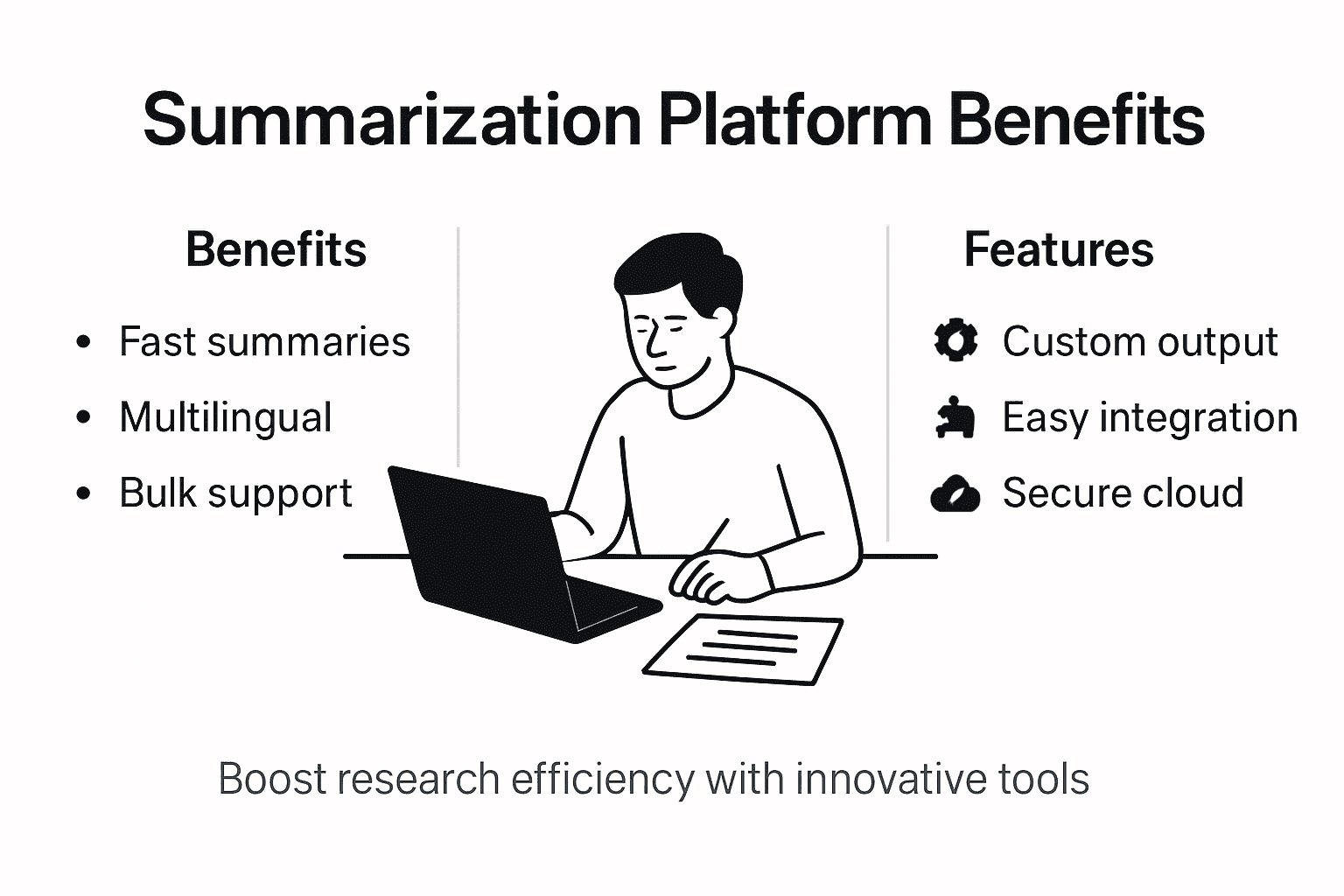
Platform features are strategically designed to support diverse research needs across academic disciplines. Subscribers can typically expect robust tools including real-time summarization, multilingual support, browser extensions, and integrated note-taking capabilities. The most advanced platforms offer additional functionalities like collaborative research spaces, automatic reference generation, and personalized content recommendations based on individual research interests and historical usage patterns.
Below is a summary of key advanced features offered by leading summarization platforms:
| Platform Feature | Research Benefit | Typical User Group |
|---|---|---|
| Bulk document summarization | Accelerates literature reviews | Graduate students |
| Citation management | Eases source referencing | Academic researchers |
| Collaborative research spaces | Enables team knowledge sharing | Institutional users |
| Multi-format export | Simplifies dissemination | Professional analysts |
Pro Tip: When evaluating subscription-based research platforms, carefully assess the breadth of features against your specific research workflow to maximize your productivity and knowledge acquisition.
Common Mistakes and Privacy Considerations
Researchers and students must be acutely aware of potential pitfalls when utilizing AI-powered summarization platforms with robust data protection mechanisms. The most critical challenges involve maintaining academic integrity, understanding platform limitations, and protecting sensitive research materials through informed decision-making.
One prevalent mistake is over-relying on AI-generated summaries without critical manual review. Automated tools can compress complex academic concepts, potentially losing nuanced interpretations or critical context. Users must develop a balanced approach that leverages AI efficiency while maintaining scholarly diligence. This involves cross-referencing summaries with original sources, verifying key arguments, and using summarization tools as supplementary research aids rather than definitive knowledge repositories.
Privacy considerations demand meticulous attention to data security protocols. Researchers should thoroughly investigate platforms’ encryption standards, data handling policies, and intellectual property protections. Critical evaluation criteria include understanding how research materials are stored, processed, and potentially shared, ensuring compliance with institutional guidelines and maintaining the confidentiality of unpublished or sensitive academic work. Subscribers must carefully review terms of service, focusing on data ownership, retention policies, and potential third-party data access mechanisms.
Pro Tip: Always maintain a local backup of original research documents and carefully review a platform’s data privacy policy before uploading any sensitive academic materials.
Maximize Your Research Efficiency with SummYT
The challenge of distilling lengthy academic videos and professional webinars into usable insights can be overwhelming. This article highlights key pain points such as information overload, the need for quick comprehension, and maintaining academic integrity through accurate, AI-powered summarization. SummYT tackles these issues head on by automatically generating clear, concise summaries from any YouTube video—helping you absorb lectures, tutorials, and industry talks without the usual time drain.
Experience the power of transforming video learning today with unlimited AI-generated summaries, multilingual support, and convenient browser extensions designed for effortless access anytime, anywhere. Discover how SummYT works and join others who are turning hours of viewing into minutes of learning. Let SummYT be your indispensable tool to stay ahead in research and professional development.
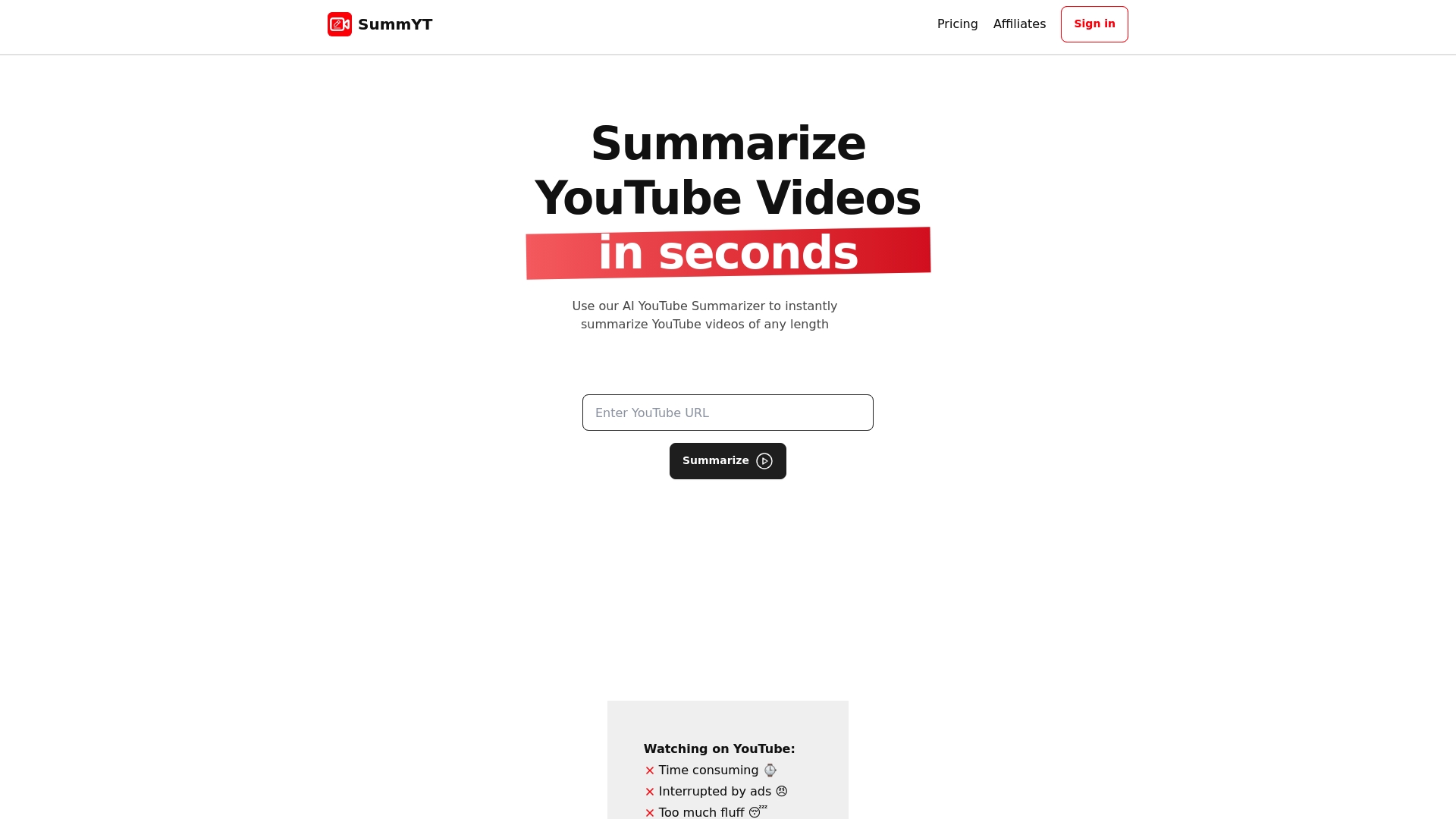
Ready to streamline your video-based research workflow? Visit SummYT now to start saving time and gaining more knowledge faster. Don’t let long videos slow you down—embrace efficient learning with SummYT today.
Frequently Asked Questions
What are subscription-based summarization services?
Subscription-based summarization services are platforms that use artificial intelligence to create concise summaries of complex multimedia content, such as academic lectures and professional webinars, allowing users to quickly grasp key insights without watching entire recordings.
How do extractive and abstractive summarization models differ?
Extractive summarization models select and present the most important sentences verbatim from the original content, while abstractive models generate new summaries by rephrasing and synthesizing information, making them more concise and readable.
What are the key features to look for in a summarization service?
Key features to consider include multilingual support, customizable summary lengths, integration with academic databases, citation management, and user-friendly interfaces that facilitate easy access across devices.
How can I ensure the privacy and security of my research materials while using these platforms?
To ensure privacy and security, review the platform’s data handling policies, encryption standards, and terms of service. Maintaining a local backup of original documents and understanding data ownership rights can also safeguard sensitive academic materials.