Role of Multilingual Summaries in STEM Video Learning

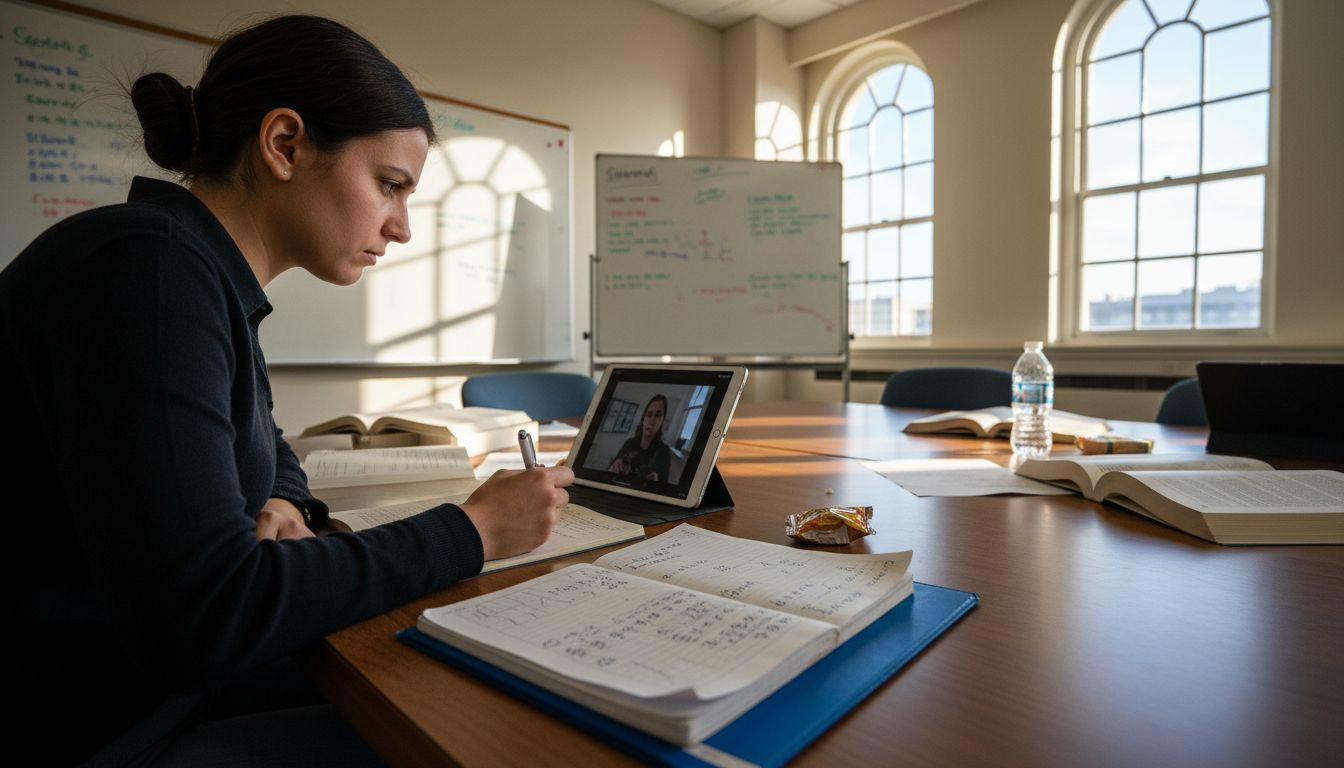
More than eighty percent of STEM scholars struggle to access educational content across language barriers, even as American research drives innovation worldwide. For graduate students and researchers, understanding complex lectures in multiple languages is not just a convenience but a necessity for global collaboration and career growth. Discover how multilingual summaries transform YouTube STEM lectures into concise, accessible knowledge, making advanced scientific ideas available to every learner, regardless of their background.
Table of Contents
- Defining Multilingual Summaries And Core Concepts
- Key Types And Technical Mechanisms For STEM Videos
- How AI Drives Reliable Multilingual Summarization
- Educational, Research, And Career Applications
- Barriers, Inaccuracies, And Best Practices In Use
Key Takeaways
| Point | Details |
|---|---|
| Multilingual Summaries Enhance Accessibility | Multilingual summaries make complex STEM content accessible to global audiences, breaking down linguistic barriers in education and research. |
| AI Drives Accurate Summarization | Advanced AI technologies improve multilingual video summarization by preserving technical precision and comprehensibility across languages. |
| Collaboration in Research is Fostered | These summaries facilitate global scientific collaboration, enabling faster knowledge transfer and comprehensive literature reviews among researchers. |
| Career Opportunities Expand | Multilingual communication tools enhance career development by providing broader access to international resources and opportunities in STEM fields. |
Defining multilingual summaries and core concepts
Multilingual summaries represent sophisticated knowledge translation tools designed to bridge educational content across linguistic boundaries in STEM fields. These advanced resources transform complex academic and scientific video content into concise, accessible narratives that transcend language limitations. At their core, these summaries distill intricate technical information into clear, comprehensible formats that enable researchers, students, and professionals worldwide to access critical knowledge regardless of their native language.
Core STEM concepts form the fundamental building blocks of scientific understanding, representing enduring, discipline-specific ideas crucial for learning and knowledge acquisition. In the context of multilingual video summarization, these concepts become translation points that maintain intellectual integrity while adapting to diverse linguistic contexts. Effective multilingual summaries must preserve not just linguistic meaning, but also the nuanced technical precision inherent in scientific communication.
The primary components of multilingual summaries include precise technical terminology translation, contextual adaptation, and maintaining scientific rigor across language boundaries. These summaries typically involve sophisticated natural language processing techniques that go beyond literal translation, incorporating disciplinary context, technical vocabulary, and domain-specific semantic structures. By leveraging advanced AI and machine learning algorithms, multilingual summarization tools can capture the intricate details of STEM lectures while presenting them in multiple languages with remarkable accuracy.
Pro Tip: When creating or consuming multilingual STEM summaries, always cross-reference technical terms and verify the translation’s scientific accuracy to ensure comprehensive understanding.
Key types and technical mechanisms for STEM videos
STEM video formats encompass a diverse range of educational content designed to facilitate complex scientific and technical learning. These videos typically include lecture recordings, laboratory demonstrations, computational tutorials, research presentations, and interactive problem-solving sessions. Each format serves a unique pedagogical purpose, enabling learners to engage with intricate technical concepts through visual and auditory representations that transcend traditional text-based learning methods.
The technical mechanisms underlying STEM video summarization have evolved dramatically, with advanced AI applications combining speech recognition, optical character recognition, and natural language processing to extract key educational content. These sophisticated systems leverage machine learning algorithms to identify and distill critical information from complex video lectures, transforming hours of technical content into concise, comprehensible summaries. The process involves multiple sophisticated techniques such as semantic analysis, concept mapping, and contextual understanding to preserve the intellectual depth of scientific communication.

Multiple technical approaches characterize modern STEM video summarization, including semantic segmentation, temporal concept tracking, and intelligent content extraction. These methods analyze video content through intricate layers of analysis, breaking down lectures into structured segments that capture core scientific principles, methodological explanations, and critical research insights. By integrating computational linguistics, computer vision, and domain-specific knowledge representations, these technologies can generate multilingual summaries that maintain the technical precision and nuanced understanding essential in scientific communication.
Pro Tip: When analyzing STEM video summaries, focus on the clarity of technical explanations and the preservation of original conceptual integrity rather than relying solely on abbreviated content.
How AI drives reliable multilingual summarization
Artificial Intelligence has revolutionized the landscape of multilingual video summarization, transforming how complex educational content is processed and translated across linguistic boundaries. Advanced AI systems now employ sophisticated techniques like speech-to-text conversion, optical character recognition, and large language models to extract and translate key concepts with unprecedented accuracy. These intelligent technologies go beyond simple translation, capturing the nuanced semantic and contextual meanings inherent in scientific and technical communication.
The core strength of AI-driven multilingual summarization lies in its ability to handle diverse linguistic challenges through advanced machine learning algorithms. By continuously training on extensive multilingual datasets, these systems develop remarkable capabilities to recognize and interpret domain-specific terminology, technical jargon, and complex scientific concepts across different languages. The computational linguistics approach enables AI to maintain the intellectual integrity of the original content while making it accessible to global audiences, effectively breaking down language barriers in academic and research communication.
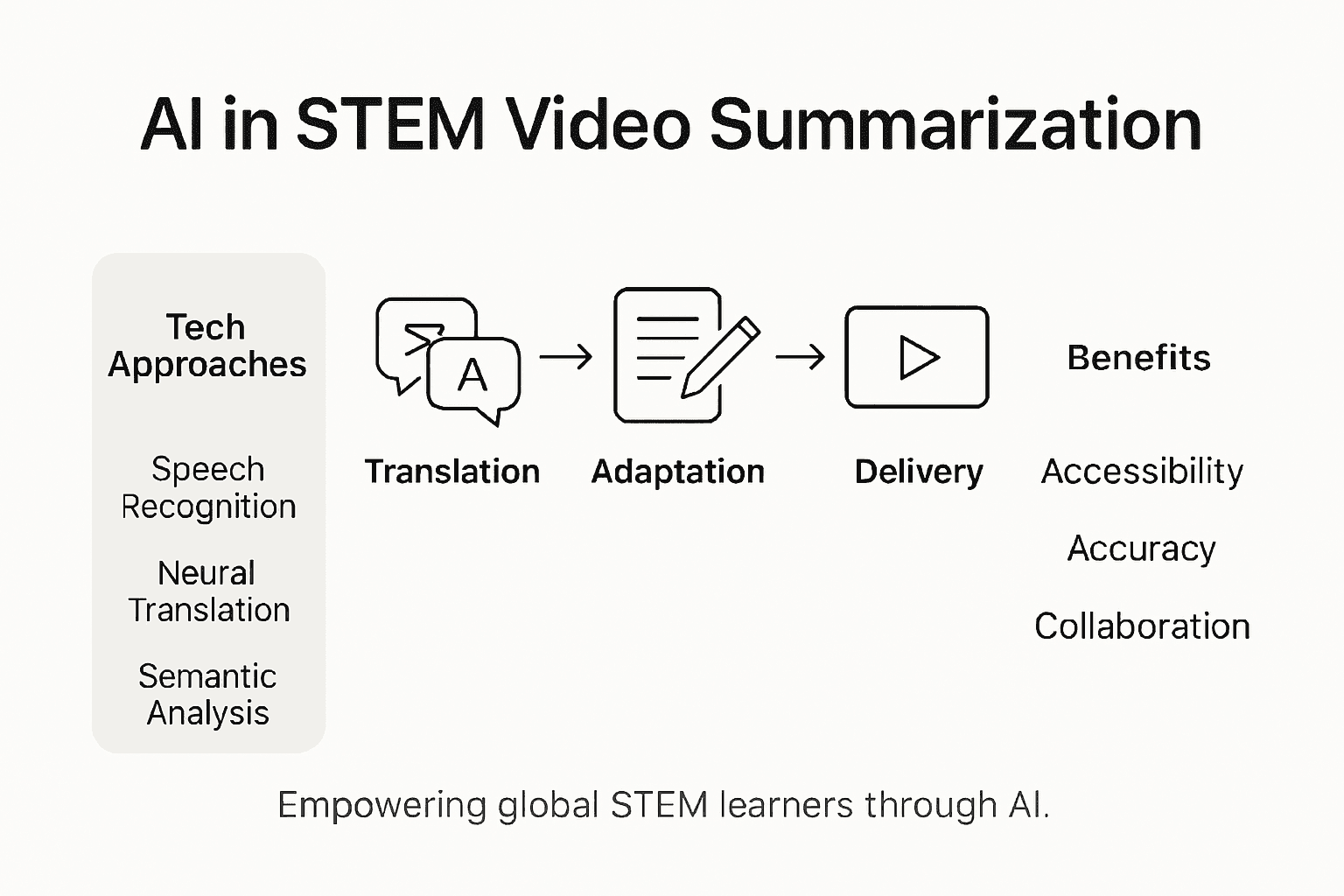
Multilingual AI summarization leverages several sophisticated technological approaches, including neural machine translation, semantic segmentation, and contextual understanding. These methods work in concert to analyze video content at multiple levels, identifying key scientific principles, methodological explanations, and critical research insights. The AI systems can dynamically adjust linguistic nuances, preserve technical precision, and generate summaries that retain the original content’s depth and educational value across different language contexts.
Here is a summary of key AI techniques used in multilingual STEM video summarization:
| Technique | Main Function | Impact on STEM Content |
|---|---|---|
| Speech Recognition | Converts spoken words to text | Enables content extraction from lectures |
| Optical Character Recognition | Reads text from visuals | Captures equations and slides |
| Neural Machine Translation | Translates text across languages | Preserves technical meaning |
| Semantic Analysis | Understands context and meaning | Retains conceptual accuracy |
| Concept Mapping | Links terms to core ideas | Ensures consistency and clarity |
Pro Tip: When evaluating AI-generated multilingual summaries, focus on the accuracy of technical terminology and the preservation of conceptual complexity rather than relying solely on literal translations.
Educational, research, and career applications
Multilingual summaries have transformed STEM education by creating unprecedented opportunities for inclusive and accessible learning environments. Evidence-based instructional interventions demonstrate that multilingual content significantly improves reading comprehension, vocabulary acquisition, and overall student engagement in scientific disciplines. These approaches directly address educational inequities by providing linguistic bridges that enable students from diverse backgrounds to access complex scientific knowledge more effectively.
In the research domain, multilingual summaries play a critical role in facilitating global scientific collaboration and knowledge dissemination. Researchers increasingly rely on these advanced summarization techniques to overcome language barriers, enabling more comprehensive literature reviews, cross-cultural research partnerships, and rapid knowledge transfer across international academic communities. The ability to quickly comprehend and synthesize research content from multiple linguistic sources accelerates scientific discovery and promotes more inclusive, globally connected research ecosystems.
Career development in STEM fields has been dramatically enhanced by multilingual communication technologies. Professionals can now access international conferences, research publications, and technical training materials with unprecedented ease, regardless of their native language. This linguistic accessibility opens new career pathways, supports professional mobility, and creates more equitable opportunities for talent development across different global scientific and technological sectors. By breaking down language barriers, multilingual summaries enable individual researchers and professionals to participate more fully in the global knowledge economy.
The following table compares educational, research, and career applications of multilingual summaries:
| Application Domain | Key Benefit | Typical Users |
|---|---|---|
| Education | Increases access and engagement | Students, educators |
| Research | Fosters global collaboration | Researchers, reviewers |
| Career Development | Expands international opportunities | Professionals, trainees |
Pro Tip: Actively seek out multilingual learning resources and practice translating technical concepts across languages to enhance your global STEM communication skills.
Barriers, inaccuracies, and best practices in use
Multilingual STEM learning encounters significant challenges that require sophisticated strategies to overcome. Best practices emphasize asset-oriented pedagogies that leverage students’ linguistic resources and integrate technology carefully to mitigate potential translation inaccuracies. These approaches recognize the complex linguistic landscapes students navigate, addressing potential comprehension barriers through nuanced, culturally responsive instructional techniques.
The primary barriers in multilingual STEM content summarization include technical terminology translation complexity, varied learner backgrounds, and potential algorithmic limitations. Automated summarization technologies often struggle with domain-specific jargon, contextual nuances, and precise scientific terminology. Researchers recommend a hybrid approach that combines technological capabilities with human expertise, ensuring accuracy and maintaining the intellectual integrity of scientific communication. This strategy involves continuous assessment, expert review, and iterative improvement of multilingual translation mechanisms.
Developing effective multilingual STEM learning environments requires comprehensive strategies that extend beyond simple translation. Educators and technology developers must collaborate to create robust systems that account for linguistic diversity, cultural context, and disciplinary specificity. This involves developing sophisticated AI models capable of understanding contextual subtleties, investing in professional development for educators, and creating inclusive curriculum designs that recognize and celebrate linguistic pluralism in scientific education.
Pro Tip: Cross-reference automated multilingual summaries with expert-reviewed sources and always maintain a critical perspective on technological translation accuracy.
Unlock the Power of Multilingual STEM Learning with AI Summaries
Navigating complex STEM video content in multiple languages can be overwhelming and time consuming. The article highlights the challenge of preserving technical precision while breaking down language barriers in educational videos. If you struggle with understanding detailed lectures, research presentations or tutorials across different languages, SummYT offers a breakthrough. Our AI-powered YouTube summarizer creates clear, concise summaries that capture core STEM concepts and multilingual nuances, saving you hours of decoding jargon or poorly translated content.
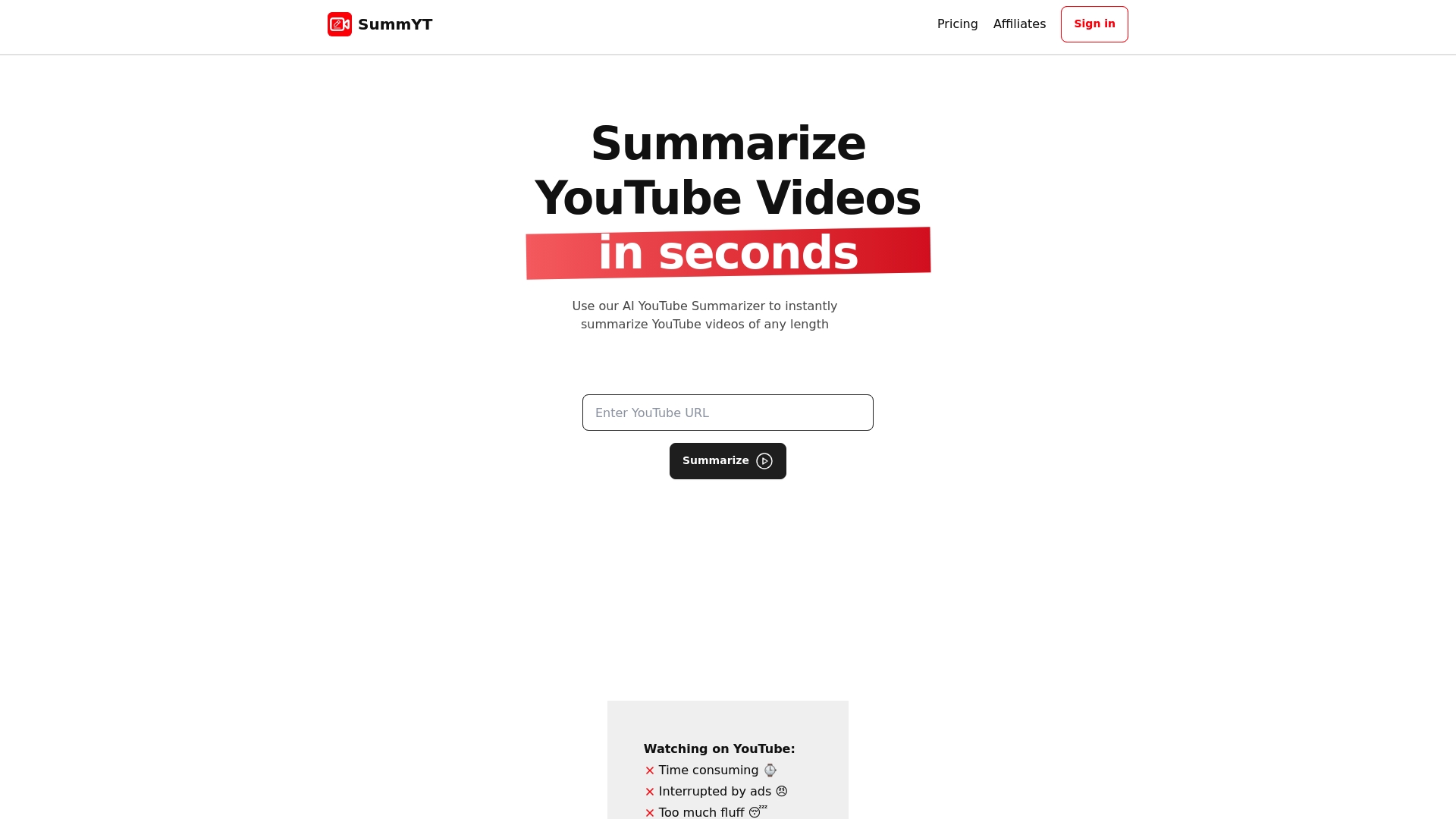
Experience how SummYT transforms the way you engage with STEM videos on our landing page. With unlimited summaries, multilingual support, and intelligent extraction of key insights, you can master difficult content fast. Whether you are a student, researcher, or professional eager to stay ahead, start using SummYT now to access precise learning without language frustration. Visit SummYT and unlock video understanding like never before.
Frequently Asked Questions
What are multilingual summaries in STEM video learning?
Multilingual summaries are knowledge translation tools that transform complex STEM video content into concise narratives accessible in multiple languages, enabling learners worldwide to understand scientific concepts regardless of language barriers.
How do multilingual summaries improve understanding in STEM education?
They enhance comprehension by providing clear, accessible explanations of intricate technical information, allowing students from diverse backgrounds to engage with complex scientific content more effectively.
What AI techniques are used in creating multilingual summaries for STEM videos?
Techniques include speech recognition, optical character recognition, neural machine translation, semantic analysis, and concept mapping, all of which work together to ensure accurate translation and preservation of technical meaning.
What challenges exist in the creation of multilingual summaries for STEM content?
Challenges include the complexity of technical terminology translation, differences in learner backgrounds, and potential limitations of automated systems. Combining technology with human expertise helps mitigate these issues.