What Is AI‑Powered Comprehension? Complete Guide


Artificial intelligence now shapes the daily lives of millions of American students, workers, and researchers without them even realizing it. With AI comprehension tools able to scan and summarize documents up to fifty times faster than a human reader, the way we process information is rapidly evolving. This shift is not just about convenience for American users but marks a new era in how knowledge is understood, shared, and applied across education and industry.
Table of Contents
- Defining AI‑Powered Comprehension
- Extractive vs Abstractive AI Methods
- How AI Comprehension Systems Work
- Applications in Video and Education
- Limitations and Risks of AI Comprehension
- Best Practices and Alternatives
Key Takeaways
| Point | Details |
|---|---|
| AI-Powered Comprehension | Utilizes advanced algorithms to analyze and synthesize data rapidly, transforming information processing. |
| Extractive vs Abstractive Methods | Employs both methods in summarization, extracting key sentences or generating new interpretations to enhance understanding. |
| Applications in Education | Offers personalized learning experiences by breaking down complex video content into digestible segments for better comprehension. |
| Limitations and Risks | Faces challenges such as transparency, bias, and the need for human oversight to ensure effective and ethical use. |
Defining AI‑Powered Comprehension
AI-powered comprehension represents a groundbreaking technological approach that transforms how humans interact with and process information. At its core, this advanced methodology uses artificial intelligence algorithms to analyze, interpret, and synthesize complex data sets with unprecedented speed and accuracy. Think of it as a sophisticated digital translator that doesn’t just convert language, but understands context, nuance, and deeper meaning.
The fundamental mechanism of AI-powered comprehension involves multiple sophisticated processes. Machine learning models are trained on vast datasets, enabling them to recognize patterns, extract key insights, and generate meaningful summaries across various content types. These intelligent systems can break down intricate information into digestible segments, identifying critical connections that might escape human perception. By leveraging advanced AI summarization techniques, these tools can rapidly process lectures, research papers, videos, and documents with remarkable precision.
Key characteristics of AI-powered comprehension include its ability to transcend traditional linear reading approaches. Unlike human comprehension, which is limited by cognitive constraints, AI can simultaneously analyze multiple dimensions of information. These systems do not just read text - they understand semantic relationships, contextual implications, and potential knowledge gaps. Computational linguistics and neural network technologies work in tandem to create intelligent comprehension frameworks that can adapt and learn from each interaction.
Practical applications of AI-powered comprehension span numerous professional and academic domains. Researchers can use these tools to quickly synthesize complex academic literature, students can obtain nuanced summaries of challenging educational materials, and professionals can extract critical insights from lengthy reports or presentations. The technology represents more than a convenience - it’s a paradigm shift in how we process, understand, and interact with information in an increasingly data-rich world.
Extractive vs Abstractive AI Methods
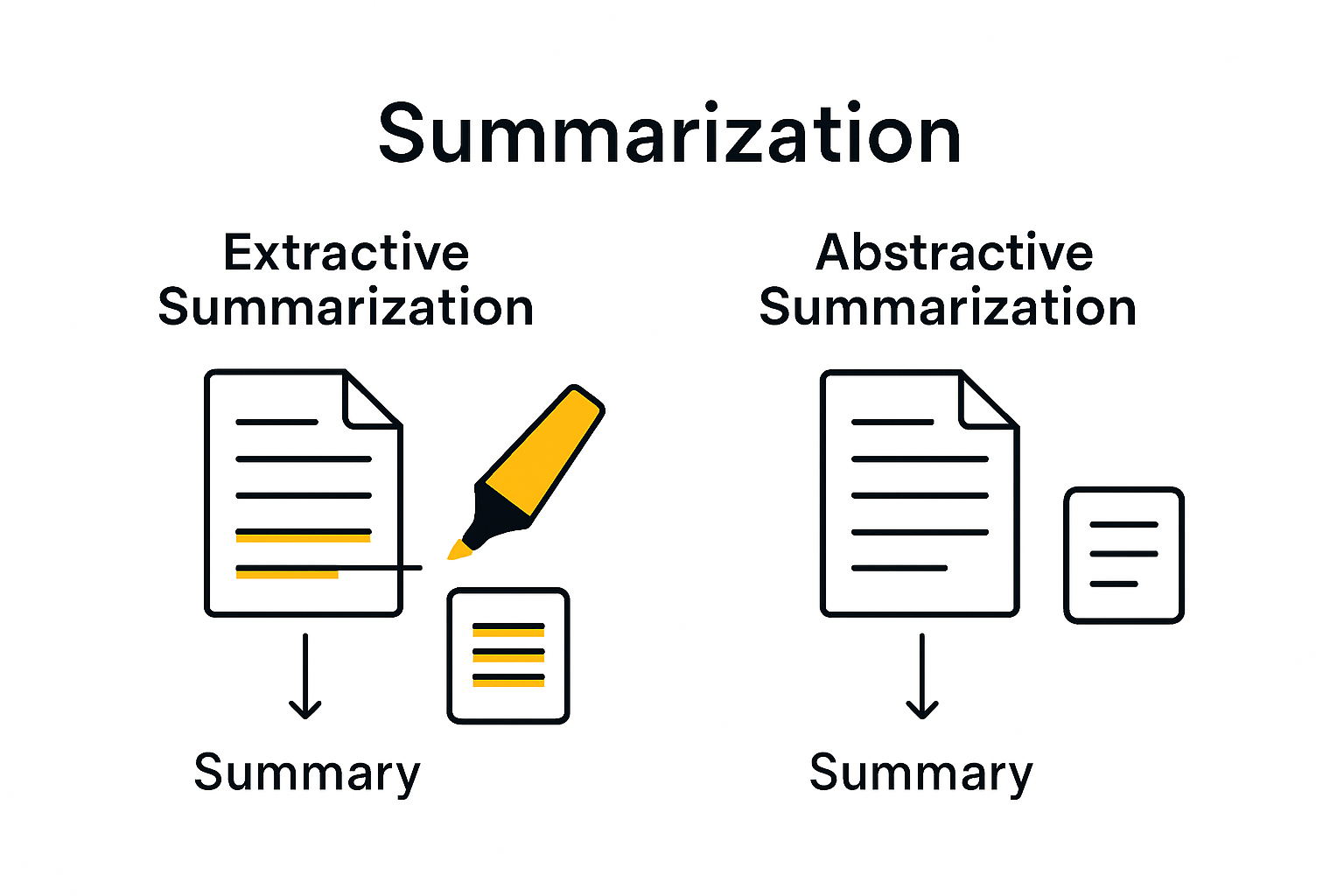
AI-powered summarization technologies primarily operate through two distinct methodological approaches: extractive and abstractive methods. Research indicates that extractive summarization selects and preserves the most important original sentences from source content, while abstractive summarization generates entirely new sentences that capture the essence of the original text.
In extractive summarization, machine learning algorithms analyze the source document and identify key sentences based on statistical significance, semantic importance, and contextual relevance. These systems use techniques like ranking algorithms, graph-based models, and natural language processing to determine which existing sentences best represent the overall content. Think of it as a highlighter that selects the most crucial passages from a document, presenting them in their original form.
Abstractive summarization represents a more advanced approach where AI doesn’t just copy existing text, but generates novel sentences that synthesize the core meaning. Advanced AI models are now exploring ‘Extract-and-Abstract’ frameworks that combine both methodological approaches. These sophisticated systems use deep learning neural networks to understand semantic relationships, allowing them to rewrite and restructure information while maintaining the original document’s core message.
Practical applications of these methods vary across different domains. Content summarization tools leverage these techniques to provide concise overviews of research papers, news articles, academic texts, and multimedia content. Whether extracting critical sentences or generating entirely new summaries, these AI methods are revolutionizing how we consume and understand complex information, transforming massive data streams into accessible, meaningful insights.
How AI Comprehension Systems Work
AI comprehension systems represent complex technological ecosystems designed to transform raw information into meaningful insights. Advanced transformer language models play a critical role in analyzing and interpreting diverse content types, utilizing sophisticated algorithms that go far beyond traditional text processing techniques.
The core mechanism of these systems involves multiple interconnected stages of information processing. Machine learning algorithms first tokenize and analyze input data, breaking down complex texts into manageable semantic units. Transformer-based models then apply contextual understanding, identifying nuanced relationships between words, phrases, and concepts. These intelligent systems can recognize linguistic patterns, extract critical information, and generate summaries that capture the essential meaning of original content.

Key technological components include neural networks, natural language processing algorithms, and deep learning architectures. These systems leverage massive training datasets to develop increasingly sophisticated comprehension capabilities. AI summarization tools can now understand context, detect subtle semantic connections, and generate human-like summaries across multiple languages and content domains. The learning process is continuous, with each interaction refining the system’s ability to interpret and synthesize information.
Practical applications of AI comprehension systems span numerous professional and academic fields. From research analysis and content creation to educational support and knowledge management, these technologies are transforming how we interact with and understand complex information. By rapidly processing and distilling large volumes of data, AI comprehension systems enable users to extract meaningful insights quickly, bridging the gap between information overload and actionable knowledge.
Applications in Video and Education
Artificial intelligence in education represents a transformative approach to learning, leveraging advanced technologies to create more personalized and adaptive educational experiences. AI-powered comprehension systems are revolutionizing how students interact with educational content, particularly in video-based learning environments where traditional methods often fall short.
In video-based education, AI comprehension systems offer unprecedented capabilities for content analysis and personalized learning. Adaptive learning technologies can dynamically adjust content complexity, generate targeted summaries, and provide personalized insights that match individual student learning styles. These systems break down complex video lectures into digestible segments, helping students grasp challenging concepts more effectively by highlighting key information and providing contextual understanding.
Educational use of video summarizers enable students and educators to extract maximum value from multimedia content. Advanced AI algorithms can identify critical learning points, generate concise summaries, and even provide interactive study materials derived from video lectures. This technology is particularly powerful for students with different learning preferences, allowing them to engage with educational content through multiple modalities - watching, reading summaries, and reviewing key insights.
The broader implications of AI-powered comprehension in education extend beyond individual learning experiences. These technologies are creating more inclusive and accessible educational environments, breaking down traditional barriers to understanding complex information. By transforming how knowledge is consumed and processed, AI comprehension systems are not just tools, but fundamental enablers of more effective, personalized, and engaging learning experiences across academic and professional domains.
Limitations and Risks of AI Comprehension
AI comprehension technologies, despite their remarkable capabilities, are not without significant challenges. The ‘black box’ nature of AI models introduces profound concerns about transparency, accountability, and the underlying decision-making processes that drive these sophisticated systems. This inherent opacity means that even advanced AI technologies can produce results without providing clear explanations for their reasoning.
Bias represents another critical limitation in AI comprehension systems. Machine learning algorithms are trained on existing datasets, which can inadvertently perpetuate historical prejudices and systemic inequalities present in their training data. AI literacy becomes crucial in recognizing and mitigating these potential biases, requiring users to critically evaluate and understand the limitations of AI-generated insights. The risk of reinforcing existing social, cultural, and intellectual blind spots through unchecked AI systems cannot be understated.
Understanding the advantages of AI summaries also requires acknowledging their potential shortcomings. Current AI comprehension technologies struggle with nuanced contexts, emotional intelligence, and complex interpretive tasks that require deep human understanding. They may miss subtle linguistic cues, cultural references, or intricate argumentative structures that human experts can readily perceive. This limitation becomes particularly pronounced in fields requiring profound interpretive skills, such as legal analysis, philosophical discourse, or creative writing.
Ethical considerations further complicate the landscape of AI comprehension. As these technologies become more prevalent, questions of data privacy, intellectual property, and potential misuse emerge. Users must remain vigilant, understanding that AI systems are tools to augment human intelligence, not replace critical thinking. Responsible engagement requires continuous learning, skeptical evaluation, and an understanding that while AI comprehension technologies offer remarkable capabilities, they are ultimately imperfect systems requiring human oversight and interpretation.
Best Practices and Alternatives
Effective AI comprehension requires a strategic approach that balances technological capabilities with critical human oversight. Integrating extractive and abstractive summarization techniques represents a sophisticated method for enhancing information processing, allowing users to leverage multiple approaches for more comprehensive understanding.
Practical best practices involve maintaining a critical and nuanced perspective when utilizing AI comprehension tools. Pre-trained transformer-based language models offer powerful capabilities, but users should always cross-reference critical information and maintain independent verification. Key strategies include:
- Implementing multi-source verification
- Using AI as a supplementary tool, not a singular information source
- Developing critical evaluation skills
- Maintaining awareness of potential algorithmic biases
- Regularly updating AI comprehension tools
Examples of AI summarization tools demonstrate that alternative approaches can mitigate comprehension limitations. Manual review, collaborative research methods, and hybrid human-AI workflows provide robust alternatives to purely algorithmic information processing. These approaches recognize AI as a powerful assistant rather than an infallible oracle.
Ultimately, responsible AI comprehension requires continuous learning, technological literacy, and a commitment to understanding both the remarkable potential and inherent limitations of artificial intelligence. By maintaining a balanced, critically engaged approach, users can transform AI comprehension tools from potentially unreliable systems into powerful instruments of knowledge acquisition and insight generation.
Unlock Efficient Learning with AI-Powered Video Summaries
The challenge of processing vast amounts of video content quickly is clear from this comprehensive guide on AI-powered comprehension. Whether you are a student struggling to digest educational lectures or a professional overwhelmed by lengthy webinars, the pain points are the same: time constraints, information overload, and the need for accurate, concise insights. Concepts like extractive and abstractive summarization highlight how AI can transform complex content into easy-to-understand summaries, but practical application is key for real-world impact.

Experience the power of AI comprehension in action with SummYT, the smart YouTube summarizer designed to save you time and boost productivity. It automatically creates clear, concise summaries and key takeaways from any video content—perfect for students, researchers, and lifelong learners who want to grasp complex information without watching every minute. Visit SummYT now to turn hours of video into minutes of insight and never miss a critical detail again. Don’t wait to transform your learning experience with advanced AI summarization tools that bring knowledge to your fingertips.
Frequently Asked Questions
What is AI-powered comprehension?
AI-powered comprehension involves using artificial intelligence algorithms to analyze, interpret, and synthesize complex datasets, allowing for a deeper understanding of information beyond traditional reading methods.
How do extractive and abstractive AI methods differ?
Extractive methods select and preserve important original sentences from the source material, while abstractive methods generate new sentences that capture the essence of the original content, providing a more nuanced summary.
What are the key applications of AI comprehension systems?
AI comprehension systems are applied in various domains, including research analysis, content creation, educational support, and knowledge management, enhancing how users interact with and understand complex information.
What are some limitations of AI comprehension technologies?
Limitations include a lack of transparency in AI decision-making, the potential for bias in training data, and challenges in understanding nuanced contexts and complex interpretative tasks that require human insight.