Why Summaries Boost Retention: Complete Guide


Did you know that people forget up to 70 percent of new information within a single day if they do not review it? With daily exposure to mountains of data, finding ways to hold on to key facts becomes a real challenge. Summaries offer a smart solution by turning long passages into manageable pieces, making it easier for our brains to store and recall what truly matters. This approach helps learners focus attention, cut through clutter, and remember more with less effort.
Key Takeaways
| Point | Details |
|---|---|
| Memory Retention | Effective memory retention relies on focused attention, active processing, and meaningful associations. Summaries aid this process by reducing cognitive load and making information manageable. |
| Summarization Benefits | Summaries streamline information processing, improve comprehension, and enhance memory encoding, acting as cognitive filters for complex data. |
| Cognitive Engagement | Active summarization results in deeper learning, fostering better mental organization and knowledge retrieval compared to passive reading. |
| Cautions with Summaries | Over-reliance on summaries can lead to superficial learning and critical thinking deficits, emphasizing the necessity of using them as supplementary tools rather than complete replacements. |
Table of Contents
- What Are Summaries And Retention?
- How Summaries Aid Information Processing
- Cognitive Benefits Of Summarizing Content
- Summarization In Education And Workflows
- Common Pitfalls When Relying On Summaries
What Are Summaries And Retention?
Memory retention is the incredible ability to store and retrieve information over time - a complex cognitive process that determines how effectively we learn and remember. According to research from Coursera, retention involves capturing information in both short‑term and long‑term memory through strategic processing techniques.
A summary acts like a cognitive shortcut, condensing complex information into its most essential elements. By distilling lengthy content into concise, focused insights, summaries help our brains encode and consolidate information more efficiently. Understanding how summaries aid learning reveals that this process reduces cognitive load, allowing learners to concentrate on key concepts without getting overwhelmed by excessive details.
Effective memory retention depends on several critical factors:
- Focused attention
- Active processing techniques
- Creating meaningful mental associations
- Reducing information complexity
Summaries excel at supporting these factors by presenting information in a structured, digestible format. They transform complex knowledge into manageable chunks, making it easier for our brains to process, understand, and ultimately remember important information. By strategically highlighting core ideas and eliminating unnecessary complexity, summaries become powerful tools for enhancing learning and memory retention.

How Summaries Aid Information Processing
Information processing is a complex cognitive function that transforms raw data into meaningful knowledge. According to research from Nature, summaries play a critical role in this process by acting as cognitive filters that streamline complex information into more digestible chunks, significantly reducing mental complexity.
When we encounter extensive content, our brain experiences cognitive overload. Summaries elegantly solve this challenge by distilling key insights, enabling faster comprehension and more efficient learning. Understanding the role of summaries in research demonstrates how these concise representations help our brain process information more effectively, bypassing unnecessary details and focusing on core concepts.
The information processing benefits of summaries include:
- Reducing cognitive load
- Accelerating comprehension
- Enhancing memory encoding
- Facilitating rapid knowledge acquisition
Research indicates that effective summarization aligns with evidence‑based learning strategies like active recall and spaced learning. By transforming complex materials into structured, focused representations, summaries create mental shortcuts that support faster cognitive processing and improved memory retention. They essentially act as intelligent filters, helping learners quickly extract and internalize critical information without getting overwhelmed by unnecessary complexity.
Cognitive Benefits Of Summarizing Content
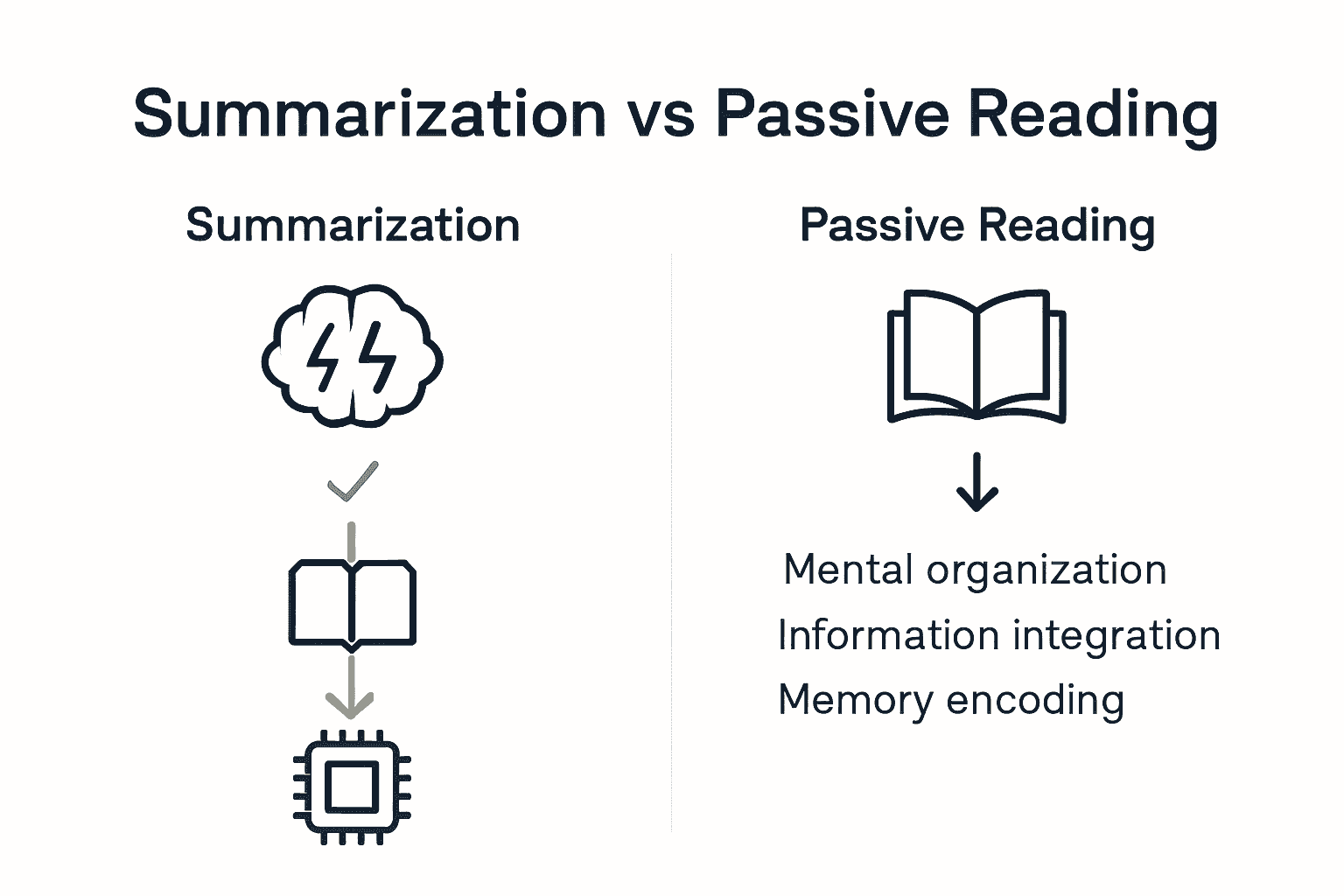
Cognitive processing transforms how we understand and retain information, and summarization emerges as a powerful mental strategy for enhancing learning. According to research by cognitive psychologist Lynne M. Reder, self‑generated summaries significantly improve information retention more effectively than passive reading or pre‑existing explanations.
When we actively summarize content, our brain engages in deep processing that goes beyond simple memorization. Understanding why learn with summaries for success reveals how this cognitive technique triggers multiple mental mechanisms that strengthen memory and comprehension. By distilling complex information into concise representations, we create mental shortcuts that make learning more efficient and memorable.
Key cognitive benefits of summarization include:
Here’s a comparison of key cognitive benefits of summarization versus passive reading:
| Benefit | Summarization | Passive Reading |
|---|---|---|
| Mental organization | Enhanced | Minimal improvement |
| Information integration | Improved | Weak |
| Memory encoding pathways | Stronger | Less efficient |
| Knowledge retrieval | More effective | Slower, less reliable |
| Cognitive engagement | Active, deep | Passive, shallow |
- Enhanced mental organization
- Improved information integration
- Stronger memory encoding pathways
- More effective knowledge retrieval
Psychological research demonstrates that summarizing is not just about reducing text length, but about actively restructuring information in our minds. As Coursera’s learning research indicates, techniques like creating summaries encourage deeper mental processing. By forcing our brain to identify core concepts, eliminate redundant details, and reconstruct knowledge in our own words, we transform passive consumption into an active, engaging learning experience that dramatically improves long‑term retention and understanding.
Summarization In Education And Workflows
Educational technology has transformed how we process and retain information, with summaries emerging as powerful tools for learning and professional development. According to research from Nature, summaries support critical learning strategies like active recall, spaced learning, and retrieval practice, helping students and professionals consolidate complex information more effectively.
In academic settings, summaries serve as strategic cognitive tools that accelerate comprehension and knowledge transfer. Understanding the role of summarizers for students reveals how these concise representations enable learners to quickly grasp core concepts, manage extensive information, and optimize their learning processes. By distilling complex materials into digestible insights, summaries bridge the gap between information overload and meaningful understanding.
Key applications of summarization across education and professional workflows include:
- Accelerating research processes
- Supporting adaptive learning technologies
- Enabling faster decision-making
- Improving information retention
- Facilitating knowledge transfer
Professional workflows benefit significantly from summarization techniques, transforming how information is processed and shared. Research indicates that concise summaries can dramatically improve productivity by reducing time spent deciphering complex documents, supporting quicker comprehension, and creating clear pathways for knowledge dissemination. Whether in academic research, corporate training, or professional development, summaries act as cognitive shortcuts that help individuals and teams navigate increasingly complex information landscapes more efficiently.
Common Pitfalls When Relying On Summaries
Cognitive processing demands careful navigation when using summaries, as these condensed representations can inadvertently create significant learning obstacles. According to educational research, working memory has limited capacity, and oversimplified summaries risk creating cognitive gaps by omitting essential connections and nuanced details that are crucial for comprehensive understanding.
Over-reliance on summaries can lead to superficial learning that undermines deep comprehension. Understanding the role of summaries in research highlights the danger of treating summaries as complete replacements for original content, which can potentially compromise critical thinking and detailed understanding. The brain requires context and depth to truly integrate complex information.
Key pitfalls of excessive summary dependence include:
- Losing critical contextual nuances
- Developing incomplete mental models
- Reducing critical thinking capabilities
- Missing subtle but important details
- Creating potential misunderstandings
Professional learners and students must approach summaries as supplementary tools, not comprehensive replacements. While summaries offer remarkable efficiency, they should inspire deeper exploration rather than serve as standalone knowledge. By treating summaries as starting points for understanding—not endpoints—learners can leverage these condensed insights while maintaining the intellectual rigor necessary for genuine comprehension and knowledge retention.
Struggling to Retain Key Information from Video Content?
Too often, we find ourselves drowning in long YouTube lectures and tutorials, only to walk away with a vague understanding or missing important details. The article above highlights how cognitive overload and information complexity make true memory retention a real challenge, especially when you rely on raw, unfiltered content. Summaries are proven to encode knowledge more deeply, but manually creating them is tedious and time-consuming. If you have ever wished for a more efficient way to extract concise, meaningful takeaways from hours of video, you are not alone.

Why not let SummYT do the work for you? With AI-powered technology, SummYT generates reliable, easy-to-digest summaries and key insights from any YouTube video, helping you apply active learning strategies recommended in our article within minutes. Whether you are a student, professional, or anyone eager to boost memory retention, you can:
- Skip the fluff and focus on core concepts fast.
- Make learning more active and efficient.
- Free up hours for deeper study or research by letting SummYT condense entire webinars, lectures, or tutorials for you.
Visit SummYT now and experience how effortless summary-driven learning can transform your retention and productivity today.
Frequently Asked Questions
What is the role of summaries in memory retention?
Summaries condense complex information, helping to reduce cognitive load and allowing learners to focus on key concepts, which enhances memory retention.
How do summaries aid in information processing?
Summaries act as cognitive filters that streamline extensive content into digestible chunks, accelerating comprehension and enabling more efficient learning.
What are the cognitive benefits of creating summaries instead of passive reading?
Creating summaries improves mental organization, information integration, memory encoding pathways, and knowledge retrieval compared to passive reading, resulting in a deeper understanding of the material.
What common pitfalls should I be aware of when relying on summaries?
Over-reliance on summaries can lead to losing critical contextual nuances, developing incomplete mental models, and reducing critical thinking capabilities. It’s essential to use summaries as supplementary tools, not complete replacements for original content.
Recommended
- Understanding Why Use Video Summaries for Effective Learning
- 7 Effective Ways to Summarize Lectures for Better Retention
- Understanding How Summaries Aid Learning Effectively
- Understanding the Role of Summaries in Research
- How to Create Captivating Content: Proven 2025 Tips for SMBs
- How to Write an Effective Summary of Research Paper