Understanding Video Summarization for Field Reporters


Video content is growing faster than ever and newsrooms are drowning in raw footage. A single breaking news event can produce hours of film, but the average viewer only watches a few minutes. Most people expect reporters to comb through it all by hand. Instead, smart algorithms are now doing the heavy lifting and creating summaries that hold on to every important detail.
Table of Contents
- What Is Video Summarization And Why Is It Important?
- The Role Of Video Summarization In Journalism
- How Video Summarization Works: Key Components And Techniques
- Real-World Applications Of Video Summarization For Field Reporters
- Challenges And Future Trends In Video Summarization
Quick Summary
| Takeaway | Explanation |
|---|---|
| Video summarization condenses lengthy videos | This technology transforms long videos into shorter segments, allowing for quick understanding without viewing the entire footage. |
| Extractive and abstractive approaches exist | Video summarization employs two methods: one selects actual segments, while the other generates new, concise representations of core messages. |
| Field reporters benefit significantly | Journalists can efficiently identify key moments, streamline workflows, and minimize post-production editing time through video summarization. |
| Enhances storytelling in journalism | By providing digestible content, video summarization allows reporters to engage audiences more effectively and convey complex narratives clearly. |
| Facing challenges but evolving rapidly | Current hurdles include processing scalability and capturing context, but innovations like AI are paving new avenues for improved summarization. |
What is Video Summarization and Why is it Important?
Video summarization is an advanced technological process that condenses extensive video content into shorter, more manageable representations while preserving critical information and core insights. In an era of information overload, this technique allows professionals, researchers, and content consumers to quickly understand the essence of lengthy videos without watching their entire duration.
Understanding the Core Concept
At its fundamental level, video summarization transforms lengthy visual content into compact, meaningful segments. The process involves intelligent algorithms that analyze video frames, identifying key moments, important dialogues, and significant visual transitions. According to research from ACM Digital Library, these algorithms can be categorized into two primary approaches:
To help clarify the two main video summarization approaches mentioned, here is a comparison table outlining their characteristics and differences.
| Approach | How It Works | Output Type | Use Case Example |
|---|---|---|---|
| Extractive Summarization | Selects and compiles actual segments or frames from original footage | Original content segments | Highlighting key moments from a news recording |
| Abstractive Summarization | Generates new, concise representations of the video[NULL]27s core message | New, condensed narrative summary | Creating a brief overview of an investigation |
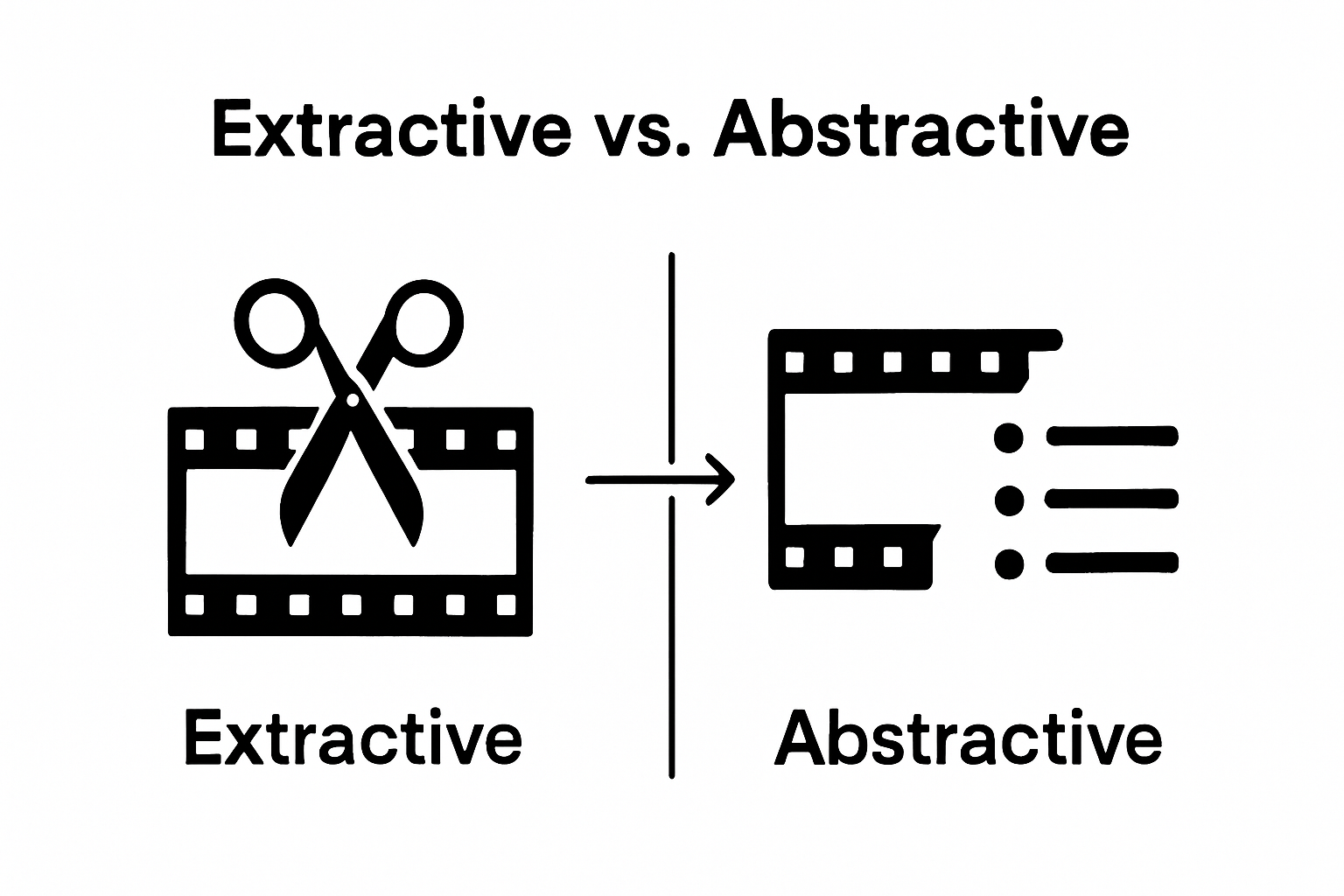
- Extractive Summarization: Selects and compiles actual video segments from the original recording
- Abstractive Summarization: Generates entirely new, condensed representations that capture the video’s core message
Why Video Summarization Matters for Field Reporters
For field reporters, video summarization is not just a convenience but a critical professional tool. Journalists often record hours of footage during investigations, interviews, or on-site reporting. Manually reviewing and extracting key moments is time-consuming and inefficient. Video summarization technologies enable reporters to:
- Quickly identify newsworthy segments
- Create concise preview clips for editorial teams
- Streamline research and content production workflows
- Reduce post-production editing time
The technological advancement in video summarization represents a significant leap in how professionals process and communicate visual information. By transforming extensive recordings into digestible content, this technique empowers field reporters to work more efficiently and deliver more focused, impactful storytelling.
The Role of Video Summarization in Journalism
Video summarization has emerged as a transformative technology in modern journalism, revolutionizing how news content is processed, analyzed, and presented. Field reporters now leverage advanced algorithms to distill hours of raw footage into concise, meaningful narratives that capture the essence of complex stories.
Enhancing News Production Workflows
Traditionally, journalists spent countless hours reviewing and editing video recordings. According to research from automated journalism studies, video summarization technologies dramatically reduce this time-consuming process. These intelligent systems quickly identify the most crucial moments, enabling reporters to:
- Extract key visual evidence and testimonials
- Create rapid story previews
- Develop more efficient content production strategies
- Reduce manual editing labor
Transforming Content Accessibility
Modern news consumers demand rapid, digestible information. Video summarization meets this need by providing compact representations of complex stories. Journalists can now create short-form video content that maintains narrative integrity while respecting audience attention spans. This approach allows news organizations to:
- Reach broader audiences across multiple digital platforms
- Provide quick insights into breaking news events
- Make complex stories more approachable and understandable
- Adapt content for different viewer engagement preferences
By integrating video summarization technologies, journalists transform their storytelling approach. These tools are not replacements for traditional reporting but powerful assistants that enhance narrative depth, efficiency, and audience connection. The technology represents a significant leap in how news stories are captured, processed, and shared in our fast-paced digital landscape.
How Video Summarization Works: Key Components and Techniques
Video summarization is a sophisticated technological process that employs advanced algorithms and computational techniques to analyze and condense complex visual content. This intricate methodology transforms raw video recordings into concise, meaningful representations that capture the core narrative and essential information.
Algorithmic Foundations
At the core of video summarization are intelligent algorithms designed to understand and process visual data systematically. According to IEEE research on video summarization techniques, these algorithms utilize multiple sophisticated approaches to extract meaningful content:
- Temporal Analysis: Evaluating video sequences based on time-based significance
- Semantic Understanding: Interpreting contextual meaning beyond visual frames
- Machine Learning Models: Employing neural networks to recognize important visual elements
Technical Processing Stages
The video summarization process involves several complex computational stages that work together to generate accurate summaries. These stages include:
- Shot Boundary Detection: Identifying distinct visual segments within the video
- Keyframe Extraction: Selecting representative frames that encapsulate critical moments
- Feature Ranking: Assessing the importance of different video segments
- Summary Generation: Compiling selected segments into a coherent, condensed representation
These advanced techniques transform video summarization from a simple cutting process into an intelligent, context-aware method of content distillation.
The main technical processing stages in video summarization can be organized in the following table to give field reporters a clear overview of each step and its function.
| Processing Stage | Purpose |
|---|---|
| Shot Boundary Detection | Identifies distinct visual segments within the video |
| Keyframe Extraction | Selects representative frames capturing critical moments |
| Feature Ranking | Assesses importance of various video segments |
| Summary Generation | Compiles selected content into a coherent, condensed representation |
Real-World Applications of Video Summarization for Field Reporters
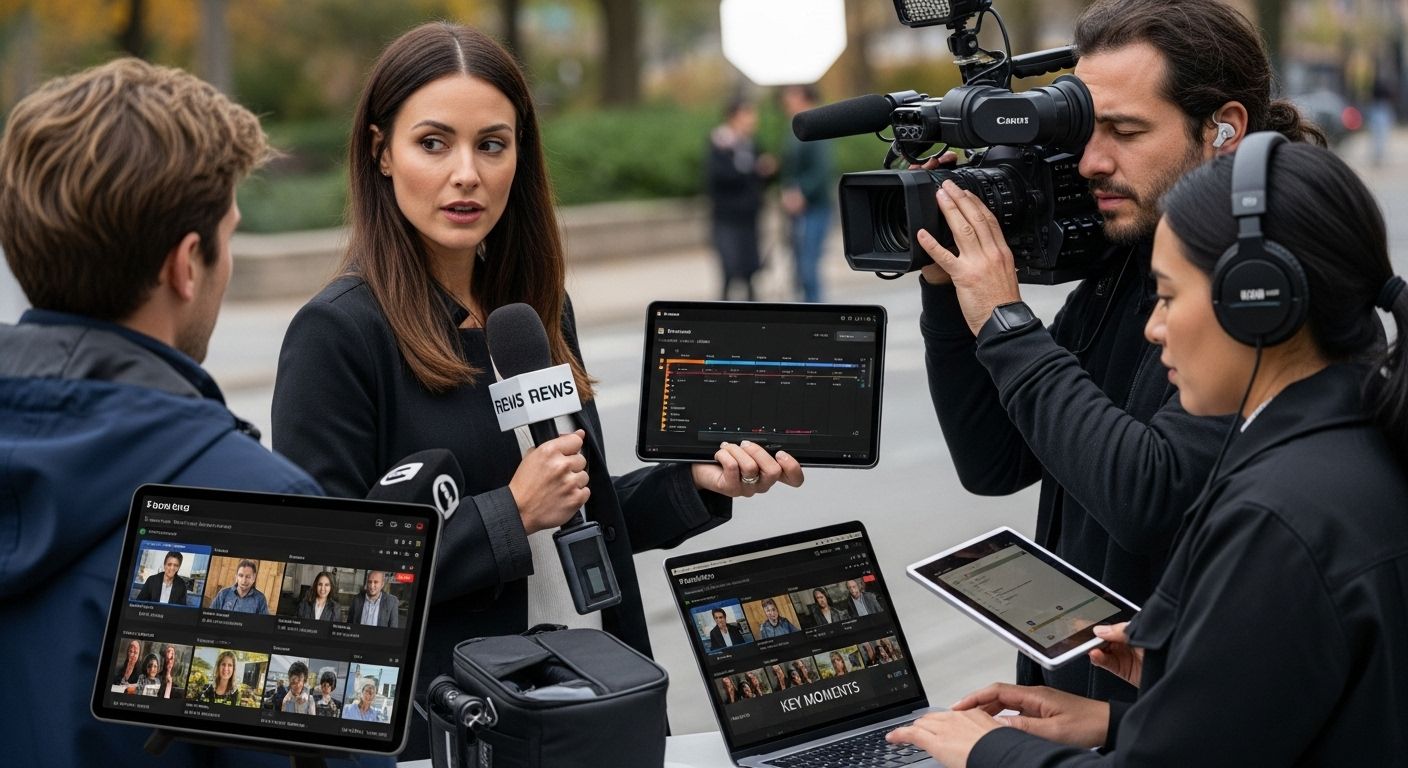
Video summarization has transitioned from a theoretical concept to a practical tool that dramatically transforms how field reporters capture, process, and communicate complex stories. By leveraging advanced technological capabilities, journalists can now convert extensive video recordings into precise, impactful narratives.
Investigative Journalism and Documentation
In investigative reporting, video summarization becomes an essential tool for processing large volumes of visual evidence. According to research from the Vision and Learning Group at UC Riverside, these technologies enable reporters to:
- Rapidly extract critical moments from extended interviews
- Identify subtle visual patterns across hours of footage
- Preserve important contextual details while reducing recording length
- Create compelling visual narratives with minimal manual editing
Emergency and On-Site Reporting
Field reporters working in dynamic environments like conflict zones, disaster areas, or rapidly evolving news events benefit significantly from video summarization technologies. These tools allow journalists to:
- Quickly synthesize complex visual information
- Highlight key events and critical developments
- Reduce cognitive load during high-stress reporting situations
- Transmit concise, accurate information to newsrooms and audiences
By transforming raw video content into focused, meaningful summaries, video summarization empowers field reporters to work more efficiently and effectively.
Here is a summary table of some key real-world benefits video summarization provides to field reporters in both investigative and emergency reporting scenarios.
| Application Area | Main Benefit | Example Activity |
|---|---|---|
| Investigative Journalism | Rapid extraction of evidence and insights | Summarizing lengthy interviews |
| Emergency and On-Site Reporting | Quick synthesis of complex situation developments | Delivering concise updates from evolving events |
Challenges and Future Trends in Video Summarization
Video summarization technology continues to evolve, facing complex technical challenges while simultaneously exploring groundbreaking innovations that promise to revolutionize how visual content is processed and understood. The landscape of this field is marked by both significant obstacles and exciting potential developments.
Current Technical Challenges
The journey of video summarization is fraught with intricate technical hurdles. According to research on video big data analytics, the primary challenges include:
- Managing scalability with exponentially growing video content
- Ensuring real-time processing capabilities
- Maintaining data privacy and security
- Capturing nuanced semantic context across diverse video types
Emerging Technological Frontiers
Innovative approaches are rapidly transforming video summarization capabilities. Researchers are exploring advanced techniques that go beyond traditional algorithmic methods:
- Integration of Large Language Models for enhanced semantic understanding
- Development of multimodal processing techniques
- Advanced machine learning models that can interpret complex visual narratives
- Artificial intelligence systems capable of understanding contextual subtleties
These emerging technologies represent more than incremental improvements. They signal a fundamental shift in how machines comprehend and distill visual information, promising more intelligent, context-aware video summarization tools that can adapt to increasingly complex multimedia environments.
Cut Your Video Research Time in Minutes – Empower Your Field Reporting Now
Field reporters know the struggle of sorting through endless video content to find the moments that matter. Wasting hours in manual review can sap your time, slow down your story, and dull your competitive edge. The article explained how video summarization transforms this process, using intelligent algorithms to identify critical points and deliver focused, actionable information. But as deadlines press and stories unfold rapidly, having the right tools is more urgent than ever.

Let SummYT supercharge your workflow. Our AI-powered summarization instantly delivers clear, concise takeaways from any YouTube video. No more sitting through irrelevant sections or missing key insights. Whether you are working on investigative journalism, documenting real-time events, or preparing for high-impact reporting, SummYT gives you:
- Unlimited summaries for all types of news or interview content
- Multilingual support to reach a global audience
- One-click access with browser extensions and mobile-friendly design
Stay ahead in the fast-moving world of news. Visit SummYT’s homepage to experience a smarter way to analyze videos and make every second of your reporting count.
Frequently Asked Questions
What is video summarization?
Video summarization is a technological process that condenses lengthy video content into shorter versions while preserving essential information and insights. It helps viewers quickly understand the video’s core message without watching the entire recording.
How does video summarization benefit field reporters?
Video summarization benefits field reporters by allowing them to quickly identify newsworthy segments, streamline their research and editing processes, and create concise previews of their content. This efficiency enhances their storytelling and improves productivity.
What are the two main types of video summarization techniques?
The two main types of video summarization techniques are extractive summarization, which selects and compiles actual video segments from the original footage, and abstractive summarization, which generates new representations that capture the video’s core message and essence.
What challenges does video summarization technology face?
Video summarization technology faces challenges like managing scalability with the growing amount of video content, ensuring real-time processing capabilities, maintaining data privacy, and accurately capturing nuanced semantic context across diverse types of video.