Digital Note-Taking Explained: Boosting Learning and Focus


Over 90 percent of American students and professionals now rely on digital note-taking tools in their daily routines. With information piling up faster than ever, finding effective ways to capture, organize, and share details can change how you learn and work. This guide breaks down what digital note-taking really means, spotlighting the surprising benefits and smart strategies that help American learners and workers keep up in a fast-moving world.
Table of Contents
- What Digital Note-Taking Really Means
- Popular Types of Digital Note-Taking Methods
- Features and Benefits of Digital Note Apps
- Real-World Uses for Students and Professionals
- Comparing Digital and Traditional Note-Taking
- Common Mistakes and How to Avoid Them
Key Takeaways
| Point | Details |
|---|---|
| Digital Note-Taking Enhances Learning | Utilizing digital note-taking tools improves information retention and workflow efficiency through dynamic, searchable notes. |
| Diverse Methods Available | Various digital note-taking methods cater to different learning styles, including text-based notes, mind mapping, and multimedia integration. |
| Real-World Applications | Students and professionals can use digital notes for research, project management, and effective communication, streamlining their workflows. |
| Avoid Common Mistakes | To maximize learning, users should focus on synthesizing information rather than merely transcribing, and avoid distractions while note-taking. |
What Digital Note-Taking Really Means
Digital note-taking represents a transformative approach to capturing, organizing, and managing information using electronic devices and software. Unlike traditional handwritten methods, this technique leverages technology to create dynamic, searchable, and easily shareable notes that adapt to modern learning and working environments. By understanding digital note-taking strategies, individuals can dramatically improve their information retention and workflow efficiency.
At its core, digital note-taking involves using computers, tablets, smartphones, or specialized software to record and structure information. The process goes beyond simple transcription, encouraging active engagement with content through features like text highlighting, voice recording, multimedia integration, and real-time collaboration. Research indicates that digital note-taking methods can balance active learning with comprehensive information processing, allowing users to capture not just words, but context and deeper insights.
The fundamental advantages of digital note-taking include:
- Instant Searchability: Unlike paper notes, digital documents can be quickly searched using keywords
- Cloud Synchronization: Notes can be accessed from multiple devices simultaneously
- Multimedia Integration: Embed images, audio clips, web links, and other rich media directly into your notes
- Collaboration Potential: Share and co-edit notes with colleagues or classmates in real time
- Enhanced Organization: Use tags, folders, and smart categorization to maintain structured information repositories
Modern digital note-taking transcends traditional boundaries, transforming how we capture, process, and interact with information across personal and professional domains.
Popular Types of Digital Note-Taking Methods
Digital note-taking has evolved into a diverse ecosystem of methods designed to capture, organize, and interact with information in increasingly sophisticated ways. Comprehensive note-taking strategies reveal a rich landscape of techniques that cater to different learning styles and professional needs. From simple text-based approaches to complex multimedia systems, these methods transform how we process and retain information.
Several prominent digital note-taking methods have emerged, each with unique strengths. The Zettelkasten system stands out as a powerful approach for researchers and knowledge workers, focusing on creating interconnected notes that facilitate deep thinking and idea generation. Mind mapping represents another crucial technique, offering visual learners a way to organize concepts spatially and understand complex relationships between ideas. Digital annotation tools have also revolutionized how professionals interact with documents, enabling real-time markup, highlighting, and collaborative insights.
The primary digital note-taking methods include:
- Text-Based Note-Taking: Simple digital document creation using word processors or dedicated note apps
- Mind Mapping: Visual representation of ideas with branching, interconnected concepts
- Zettelkasten Method: Networked note system that links related ideas across multiple documents
- Multimedia Notes: Integration of text, images, audio, and video within a single note
- Collaborative Digital Notebooks: Cloud-based platforms allowing real-time sharing and editing
Understanding these automated note-taking techniques empowers individuals to select methods that best match their cognitive preferences and professional requirements, transforming information management into a more intuitive and dynamic process.
Features and Benefits of Digital Note Apps
Digital note apps have revolutionized information management by offering sophisticated tools that transform how we capture, organize, and interact with knowledge. Note-taking automation strategies reveal an impressive array of features designed to enhance learning, productivity, and information retention across personal and professional domains.

The core strengths of digital note apps lie in their powerful multimedia integration capabilities. Unlike traditional paper notes, these applications enable users to embed text, images, audio recordings, web links, and video clips within a single dynamic document. This multisensory approach supports diverse learning styles and allows for more comprehensive information processing. Research indicates that the ability to link related notes and create interconnected knowledge networks significantly improves understanding and memory retention.
Key features and benefits of digital note apps include:
- Cloud Synchronization: Access notes from multiple devices instantly
- Advanced Search Functionality: Quickly locate specific information within extensive note collections
- Real-Time Collaboration: Share and edit notes simultaneously with team members
- Multimedia Embedding: Integrate diverse content types seamlessly
- Automatic Backup: Protect valuable information from accidental loss
- Cross-Platform Compatibility: Work across smartphones, tablets, and computers
Understanding these automated note-taking techniques empowers users to transform their information management approach, turning digital note apps into powerful cognitive enhancement tools that adapt to individual learning and working preferences.
Real-World Uses for Students and Professionals
Digital note-taking has transformed information management across academic and professional landscapes, providing powerful tools for capturing, organizing, and leveraging knowledge. Exploring essential digital learning tools reveals how these technologies enable more efficient and dynamic approaches to learning and work.
For students, digital note-taking represents a game-changing approach to academic success. These tools allow learners to compile lecture notes, research materials, and study guides with unprecedented flexibility. Collaborative features enable group project coordination, while advanced search capabilities help students quickly retrieve specific information from extensive note collections. Professionals similarly benefit from these technologies, using digital notes to track project details, compile research insights, document client meetings, and create comprehensive knowledge repositories.
Key real-world applications include:
- Academic Research: Compile and cross-reference research materials
- Project Management: Track tasks, deadlines, and collaborative workflows
- Lecture Note Organization: Capture and review classroom content efficiently
- Professional Development: Document training sessions and industry insights
- Creative Brainstorming: Generate and link innovative ideas across disciplines
- Client Communication: Log meeting details and track important conversations
Understanding productivity tools for smarter learning empowers individuals to transform their information management strategies, making digital note-taking an indispensable skill in today’s fast-paced academic and professional environments.
Comparing Digital and Traditional Note-Taking
The debate between digital and traditional note-taking methods reveals a complex landscape of cognitive advantages and technological possibilities. Note-taking strategies for maximum retention highlight the nuanced differences between analog and digital approaches, demonstrating that each method offers unique benefits for learning and information processing.
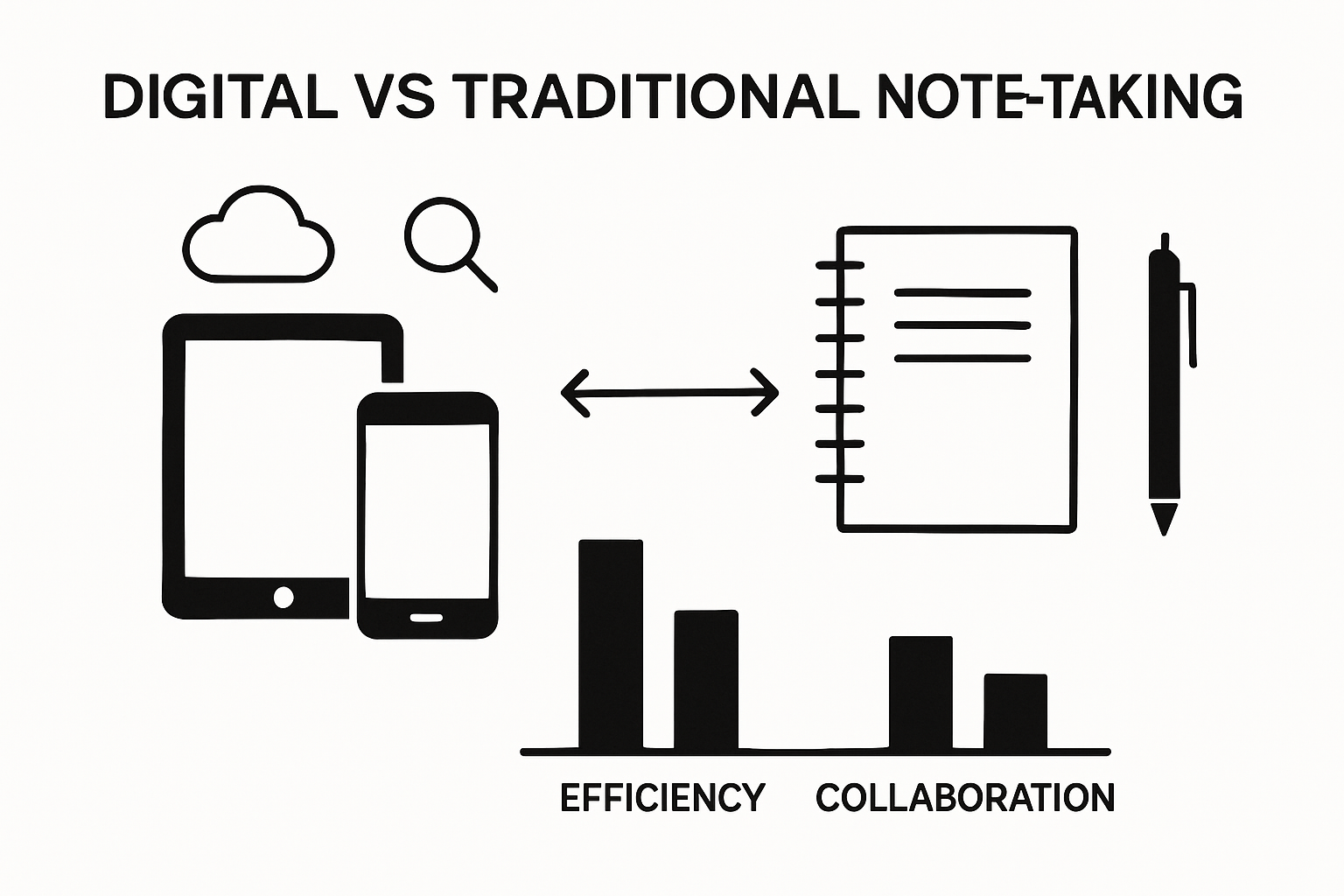
Research suggests that while digital note-taking provides unprecedented convenience and organization, handwritten notes may offer deeper cognitive engagement. Handwritten notes require more active processing, compelling students to synthesize information in real-time, which can enhance comprehension and memory retention. Digital tools, conversely, excel in searchability, multimedia integration, and instant sharing, allowing users to create more comprehensive and interconnected knowledge repositories.
Key comparative aspects include:
- Processing Speed: Handwriting encourages slower, more deliberate information synthesis
- Information Retention: Manual writing may improve memory more effectively
- Organizational Capabilities: Digital notes offer superior search and categorization
- Accessibility: Digital notes can be accessed from multiple devices
- Multimedia Integration: Digital platforms support rich, interactive content
- Collaboration: Digital tools enable real-time sharing and collective editing
Understanding these distinctions empowers learners to select optimal note-taking approaches that align with their individual learning styles and cognitive preferences.
Common Mistakes and How to Avoid Them
Digital note-taking offers powerful tools, but many users inadvertently undermine their learning potential by making common strategic errors. Productivity strategies for smarter learning reveal critical insights into transforming digital note-taking from a passive recording process into an active learning mechanism.
Research indicates that verbatim transcription represents one of the most significant pitfalls in digital note-taking. Simply copying text or lecture content word-for-word reduces cognitive engagement and prevents meaningful information processing. Instead, learners should focus on synthesizing key concepts, creating personal summaries, and connecting new information with existing knowledge frameworks. The temptation to multitask—switching between note-taking apps, messaging platforms, and web browsers—further fragments attention and diminishes comprehension.
Key mistakes to avoid include:
- Passive Copying: Transcribing without understanding or synthesizing information
- Multitasking: Allowing digital distractions to interrupt focused learning
- Overreliance on Technology: Assuming digital tools automatically improve learning
- Lack of Structure: Creating unorganized, scattered notes without clear connections
- Ignoring Context: Capturing information without understanding its broader significance
- Neglecting Review: Failing to revisit and actively process digital notes
By understanding efficient note-taking techniques, individuals can transform digital note-taking from a mechanical task into a powerful cognitive enhancement strategy.
Boost Your Learning Efficiency with Smart Digital Note-Taking Tools
The article explains how digital note-taking enhances focus and learning by transforming passive transcription into active engagement. If you have struggled with managing lengthy lecture videos or webinar content and want to maximize your study or work productivity, SummYT offers a perfect solution. By providing clear and concise AI-powered YouTube video summaries, SummYT helps you capture key insights instantly without getting overwhelmed by raw information.

Discover how you can reduce distraction and improve retention by complementing your digital notes with fast, accurate video summaries. Visit SummYT now to experience smarter note-taking in action. Learn more about automated note-taking techniques and how to avoid common productivity mistakes with our note-taking automation guide. Start saving valuable time and boost your focus today.
Frequently Asked Questions
What are the advantages of digital note-taking compared to traditional methods?
Digital note-taking offers instant searchability, cloud synchronization, multimedia integration, and enhanced organization. These features make it easier to capture, store, and retrieve information efficiently.
How can I improve my digital note-taking skills?
To enhance your digital note-taking, focus on synthesizing key concepts rather than verbatim transcription, organize your notes with tags and folders, and regularly review them to reinforce learning.
What digital note-taking methods exist, and which should I choose?
Popular methods include text-based note-taking, mind mapping, the Zettelkasten method, multimedia notes, and collaborative digital notebooks. Choose one based on your learning style and the complexity of the information you’re processing.
How do digital note-taking apps support collaboration?
Many digital note-taking apps offer real-time collaboration features, enabling users to share notes and co-edit documents simultaneously. This fosters teamwork and ensures everyone has access to the latest information.
Recommended
- Note-Taking Strategies Step by Step for Maximum Retention
- Video Note-Taking Guide: Everything You Need to Know
- Understanding Efficient Note Taking Guide for Better Learning
- Automated Note-Taking Explained: Efficient Strategies and Tools
- 7 Best Study Gadgets for Students to Boost Learning Power - Projector Display
- The Psychology of Tangible Progress in Digital Work