What Is Summary Automation? Complete Guide to Uses and Benefits


More than 2.5 quintillion bytes of data are created every day, making it harder than ever to extract what truly matters. People in every field face information overload, whether they are sorting research papers, video lectures, or business reports. Understanding summary automation opens the door to faster learning, sharper focus, and less wasted effort. This guide cuts through common myths and breaks down what automated summarization can and cannot do, helping you make informed decisions about using this technology.
Table of Contents
- Summary Automation Defined: Concepts And Misconceptions
- Key Features Of Automated Video Summarization
- Types Of Summary Automation Solutions
- Common Use Cases In Education And Work
- Risks, Limitations, And Accuracy Challenges
- Choosing Summary Automation Vs. Manual Summaries
Key Takeaways
| Point | Details |
|---|---|
| Summary Automation Enhancements | Utilizes natural language processing and computer vision to distill information into essential components for improved understanding. |
| Key Features of Video Summarization | Offers intelligent content selection, multi-length summarization, and interactive customization to cater to diverse user needs. |
| Risks of Overreliance | Users may develop a reliance on automation, leading to potential blind spots in critical decision-making due to context loss and bias reinforcement. |
| Choosing Automation vs. Manual | Automated summaries provide time efficiency, scalability, and reduced human error, making them a cost-effective solution compared to manual approaches. |
Summary Automation Defined: Concepts And Misconceptions
Summary automation is a sophisticated computational process designed to distill complex information into its most essential components. According to Wikipedia, it involves using advanced techniques like natural language processing for text and computer vision for visual content, enabling rapid extraction of key insights from large datasets.
At its core, summary automation transforms how we consume and understand information. It goes beyond simple text reduction, intelligently analyzing context, identifying critical points, and reconstructing content in a more digestible format.
This technology leverages algorithms that can recognize semantic patterns, evaluate information importance, and generate concise representations across various media types.
However, the process isn’t without challenges. The Wikipedia research on Ironies of Automation highlights potential pitfalls, such as overreliance on automated systems that might gradually diminish human analytical skills. Successful implementation requires a balanced approach that combines technological efficiency with human oversight and critical thinking.
Key characteristics of effective summary automation include:
- Maintaining original content context
- Preserving critical nuances and meaning
- Generating human-readable summaries
- Supporting multiple content formats
- Adapting to different complexity levels
For professionals seeking to understand this technology more deeply, our benefits of content summarizers guide offers comprehensive insights into how summary automation can transform information processing across various domains.
Key Features Of Automated Video Summarization
Video summarization is a sophisticated technology that transforms lengthy video content into concise, meaningful representations. ArXiv research reveals that effective automated summarization goes beyond simple frame extraction, carefully considering both visual and non-visual factors such as content diversity, interestingness, and storyline consistency.
The core functionality of video summarization encompasses multiple advanced techniques. According to ArXiv’s comprehensive study, a unified multi-faceted system can extract key frames, generate interactive skims, and create entity-specific summaries. This flexibility allows users to generate summaries of varying lengths and types, making the technology adaptable to diverse user needs.
Key features of automated video summarization include:
- Intelligent content selection: Algorithms that identify and preserve the most significant moments
- Multi-length summarization: Ability to create summaries ranging from ultra-short clips to more comprehensive overviews
- Cross-media compatibility: Support for different video formats and content types
- Semantic understanding: Advanced natural language processing to capture contextual nuances
- Interactive customization: User-controlled summary generation
Professionals seeking deeper insights can explore our guide on understanding why automate video summaries, which provides comprehensive details about this transformative technology.
Types Of Summary Automation Solutions
Summary automation technologies have evolved to address diverse content processing needs across multiple domains. Wikipedia highlights two primary categories: text summarization using natural language processing and video summarization leveraging computer vision algorithms to extract key segments and frames.
The landscape of summary automation solutions is rich and multifaceted, designed to tackle different content types and user requirements. One fascinating approach is video synopsis, which Wikipedia describes as a method that creates short, informative summaries by detecting and analyzing moving objects, ingeniously presenting activities that occurred at different times simultaneously.
Key types of summary automation solutions include:
- Text Summarization: Condensing written documents using AI-powered natural language processing
- Video Summarization: Generating concise video overviews by identifying critical moments
- Multimedia Summarization: Creating summaries across multiple content formats
- Real-time Summarization: Generating instant summaries during live events or streams
- Personalized Summarization: Adapting summary styles based on individual user preferences
Professionals looking to dive deeper into the world of automated summaries can explore our guide on summary generation techniques, which offers comprehensive insights into these transformative technologies.
Common Use Cases In Education And Work
Summary automation has revolutionized how we process and consume information across educational and professional environments. ReelMind highlights its transformative potential in education, demonstrating how this technology can break complex lectures into digestible micro-lessons, create targeted flashcards, and emphasize critical visual diagrams to enhance learning efficiency.
Microsoft Research reveals that sophisticated auto-summarization techniques leverage multiple signals like audio cues, slide transitions, and user interaction patterns to generate precise, context-aware summaries. This approach enables professionals and students to extract maximum value from lengthy presentations and educational content with minimal time investment.
Key use cases across education and professional domains include:
- Academic Research: Quickly synthesizing research papers and scholarly content
- Professional Training: Condensing lengthy training videos and webinars
- Student Learning: Creating concise study materials from lecture recordings
- Conference Proceedings: Generating executive summaries of complex presentations
- Compliance Training: Extracting critical information from regulatory materials
For educators and professionals seeking deeper insights, our guide on the role of summaries in education offers comprehensive strategies for integrating summary automation into learning and development processes.

Risks, Limitations, And Accuracy Challenges
Summary automation technologies, while powerful, are not without significant challenges. Wikipedia’s research on Automation Bias reveals a critical psychological phenomenon where users tend to over-rely on automated systems, potentially overlooking contradictory information from non-automated sources. This cognitive trap can lead to dangerous blind spots in critical decision-making processes.
The complexity of automated summarization introduces multiple technical limitations. Wikipedia’s exploration of the Ironies of Automation highlights how automation can paradoxically reduce human skill levels and increase monitoring tasks, creating new challenges that require careful, nuanced implementation. The technology must balance algorithmic efficiency with contextual understanding to maintain accuracy and relevance.
Key risks and limitations of summary automation include:
- Context Loss: Potential misinterpretation of nuanced information
- Bias Reinforcement: Algorithmic tendencies to reproduce existing biases
- Incomplete Comprehension: Difficulty understanding complex emotional or cultural contexts
- Semantic Subtleties: Challenges in capturing tone and implied meanings
- Language Complexity: Variations in communication styles and dialects
Professionals seeking to understand these challenges in depth can explore our guide on summary generation techniques, which offers comprehensive insights into navigating these technological limitations.
Choosing Summary Automation Vs. Manual Summaries
Summary automation represents a sophisticated alternative to traditional manual summarization, bridging technological efficiency with nuanced information processing. ArXiv research reveals that modern conditional modeling techniques aim to narrow the gap between human-generated and machine-generated summaries by incorporating both visual and non-visual factors, creating increasingly intelligent summarization approaches.
ArXiv’s advanced research introduces innovative techniques like Causalainer, a causal explainer for automatic video summarization that enhances performance by uncovering complex relationships in the summarization process. This breakthrough demonstrates how technological solutions are progressively matching and sometimes surpassing manual summarization capabilities.
Key considerations when choosing between summary automation and manual summaries include:
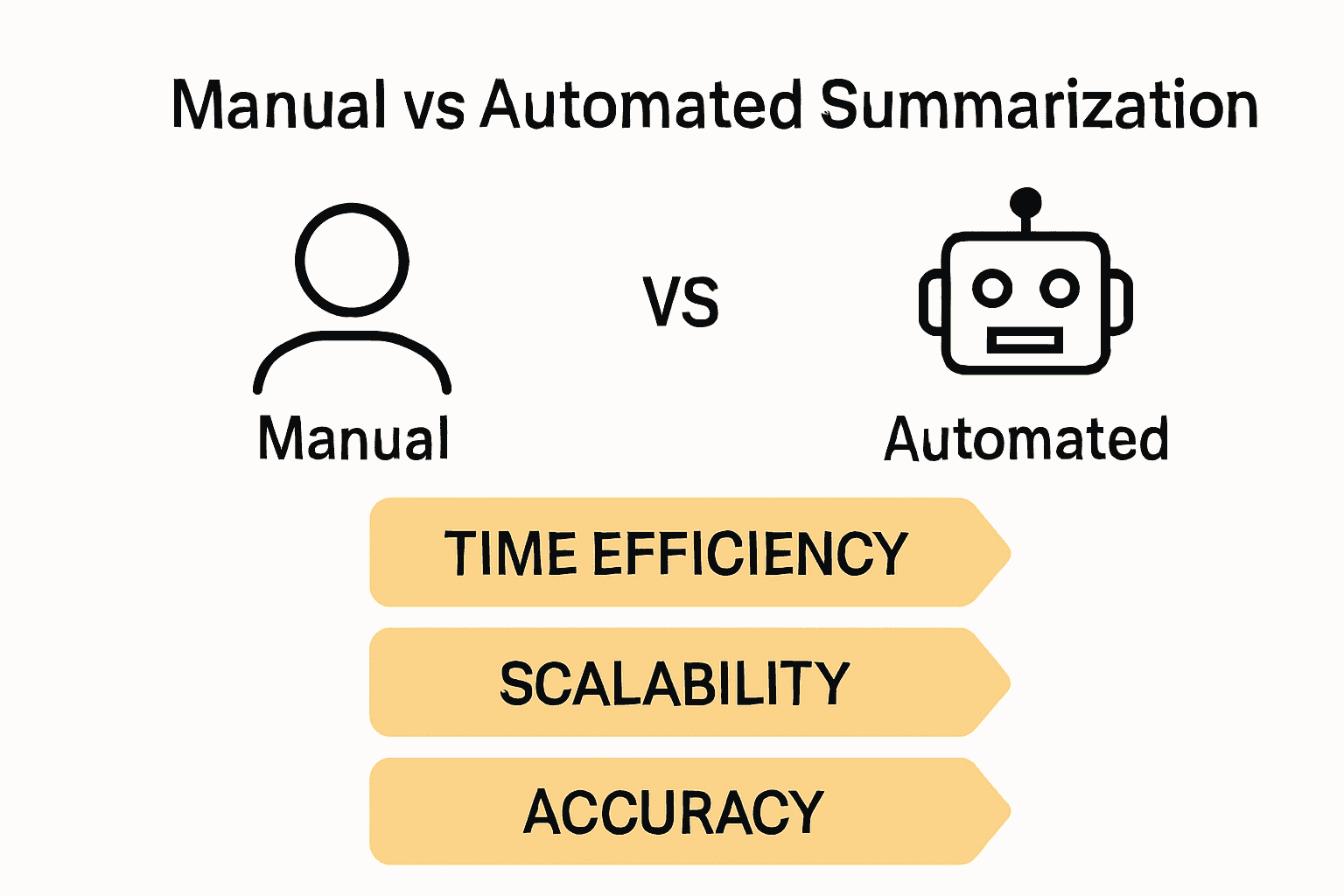
- Time Efficiency: Automated summaries generate results in seconds
- Scalability: Machine learning can process massive amounts of content
- Consistency: Reduced human error and subjective interpretation
- Cost-Effectiveness: Lower long-term expenses compared to manual labor
- Adaptability: Continuous improvement through machine learning algorithms
Professionals interested in understanding the strategic advantages can explore our guide on the advantages of automated content summaries, which offers comprehensive insights into making informed summarization choices.
Unlock the Power of Summary Automation with SummYT
The article reveals how summary automation can save time and improve understanding by breaking down complex videos and texts into clear, concise insights. If you often struggle with lengthy lectures, webinars, or interviews that demand hours of your attention, the pain of wasted time and information overload is real. Tools like intelligent content selection and personalized summarization are essential for transforming this challenge into an opportunity for faster learning and higher productivity.
SummYT harnesses these advanced summary automation concepts to help you master YouTube content effortlessly. Whether you are a student seeking quick comprehension or a professional needing crisp webinar notes, SummYT’s AI-powered platform removes fluff and distractions to deliver key takeaways in minutes. Discover the benefits of automated content summaries with our detailed advantages of automated content summaries guide and explore summary generation techniques to understand the technology behind it.
Simplify your video learning experience now at https://summyt.app and enjoy unlimited summaries, multilingual support, and seamless access on any device.
Take control of your time and knowledge today.
Start transforming your YouTube watching from hours to minutes.
Frequently Asked Questions
What is summary automation?
Summary automation is a computational process that distills complex information into essential components using techniques like natural language processing and computer vision. It transforms how we understand information by intelligently analyzing context and reconstructing content.
What are the key features of automated video summarization?
Key features of automated video summarization include intelligent content selection, multi-length summarization, cross-media compatibility, semantic understanding, and interactive customization, allowing users to generate summaries tailored to their needs.
How is summary automation used in education and professional environments?
In education, summary automation is used to create micro-lessons, targeted flashcards, and concise study materials. In professional settings, it condenses training videos and generates executive summaries, enhancing learning and information retention.
What are the risks and limitations of summary automation?
Risks of summary automation include potential context loss, reinforcement of biases, incomplete comprehension of nuanced information, challenges in understanding emotional or cultural contexts, and difficulties with language complexity.
Recommended
- Understanding the Advantages of Automated Content Summaries
- Understanding Why Automate Video Summaries Matters
- What Is Summary Generation? Complete Guide Explained
- Automated Note-Taking Explained: Efficient Strategies and Tools
- 11 Best AI Content Writing Tools (Reviews Included) 2025
- Best SEO content automation tools in 2025