Role of Summaries in Content Strategy Success


Most American professionals face a daily flood of digital information, making quick understanding a genuine challenge. With people spending nearly three hours a day on content consumption, the pressure to sift through complex material is intense. Summaries have become essential tools for turning dense topics into clear, usable insights. By using strategic summaries, American audiences can process information faster and make smarter decisions without missing the core message.
Table of Contents
- Defining Summaries In Content Strategy
- Types Of Summaries And Key Differences
- How Summaries Streamline Content Consumption
- Benefits For Professionals And Knowledge Workers
- Pitfalls And Misuse Of Content Summaries
Key Takeaways
| Point | Details |
|---|---|
| Role of Summaries | Summaries transform complex information into accessible insights, enhancing audience engagement and comprehension. |
| Types of Summaries | Understanding the difference between descriptive and evaluative summaries helps in selecting the appropriate technique for communication. |
| Streamlining Consumption | Effective summaries reduce cognitive load and improve decision-making by condensing vast amounts of content into digestible formats. |
| Potential Pitfalls | Over-reliance on summaries can lead to incomplete understanding, emphasizing the need for critical engagement with original content. |
Defining Summaries in Content Strategy
In the dynamic world of digital content, summaries serve as critical navigational tools that help audiences quickly understand complex information. Content strategy involves the systematic planning and management of content, with summaries playing a pivotal role in transforming dense material into digestible insights.
A content summary is more than just a condensed version of information. It represents a strategic approach to distilling key messages, allowing readers to grasp core concepts without consuming the entire original content. Summaries act as roadmaps guiding content marketing efforts, enabling efficient communication across multiple platforms and audience segments.
Effective content summaries share several core characteristics:
- Precision in capturing primary ideas
- Brevity that maintains context
- Clear language accessible to target audiences
- Ability to spark further interest in the complete content
Understanding summaries within content strategy requires recognizing their multifaceted purpose. They serve not just as information condensers, but as critical communication bridges that connect complex ideas with audience comprehension. Whether for academic research, professional reports, or marketing materials, well-crafted summaries can dramatically enhance content engagement and knowledge transfer.
Types of Summaries and Key Differences
Summaries play a complex and nuanced role in content strategy, with multiple approaches serving different strategic objectives. Summaries are fundamentally classified into descriptive and evaluative types, each offering unique benefits to content creators and consumers. Understanding these variations helps professionals select the most appropriate summary technique for their specific communication needs.

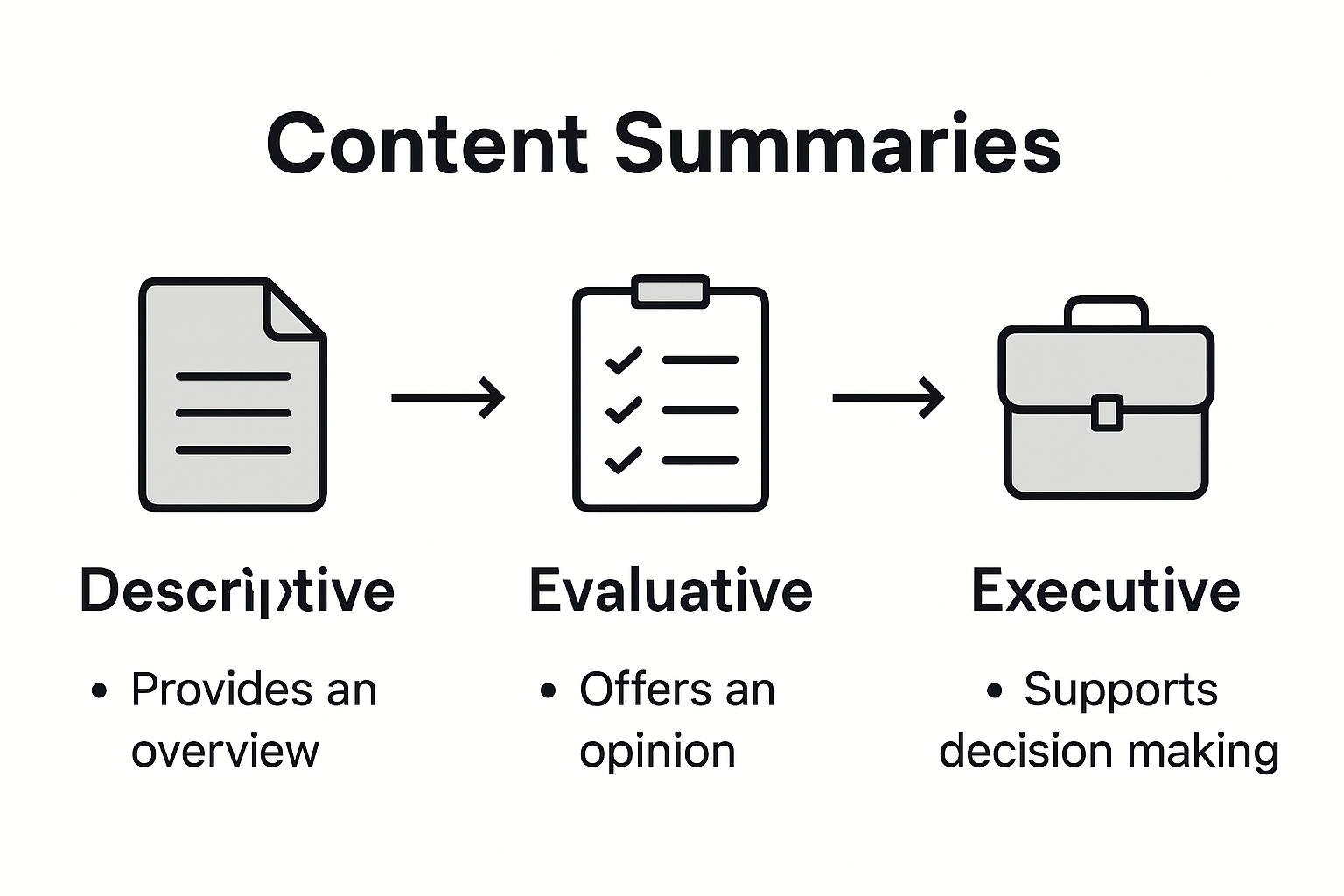
Descriptive summaries provide a neutral, objective overview of source material, focusing on presenting key information without personal interpretation. These summaries are particularly useful in academic, scientific, and research contexts where maintaining objectivity is crucial. In contrast, evaluative summaries incorporate the writer’s critical perspective, offering insights, assessments, and potential critiques of the original content.
The primary types of summaries include:
- Descriptive Summaries: Neutral, fact-based representations
- Evaluative Summaries: Analytical overviews with critical insights
- Executive Summaries: Concise reports targeting decision-makers
- Informative Summaries: Detailed explanations of complex topics
- Highlights Summaries: Quick snapshots of primary points
Comprehensive content summarization techniques demonstrate that effective summaries are not one-size-fits-all solutions. Each type serves a specific purpose, whether condensing research papers, providing quick briefings for busy professionals, or offering critical analysis for in-depth understanding. The key is selecting a summary approach that aligns with your audience’s information needs and consumption preferences.
How Summaries Streamline Content Consumption
Automatic summarization techniques have revolutionized how individuals process and consume information in the digital age. These advanced methods condense vast amounts of content into digestible formats, addressing the critical challenge of information overload that professionals and learners face daily. By transforming complex, lengthy materials into concise representations, summaries enable faster comprehension and more efficient knowledge acquisition.
The primary mechanisms of content summarization involve two sophisticated approaches. Extractive summarization identifies and preserves the most important original sentences from source material, while abstractive summarization generates entirely new sentences that capture the core meaning. Multi-document summarization techniques take this a step further by compiling information from multiple sources into a single, coherent narrative, allowing readers to understand diverse perspectives without individually reviewing each document.
Key benefits of effective summaries include:
- Rapid information processing
- Reduced cognitive load
- Enhanced decision-making speed
- Improved retention of critical insights
- Efficient cross-referencing of complex topics
Benefits of content summarizers demonstrate that strategic summarization is not just about shortening content, but about transforming how we interact with information. By intelligently distilling complex ideas into clear, accessible formats, summaries serve as powerful cognitive tools that help individuals navigate the overwhelming landscape of modern digital content.
Benefits for Professionals and Knowledge Workers
Adaptive summarization models represent a transformative approach for professionals seeking to optimize their information consumption. These intelligent systems learn from individual user preferences, creating personalized summaries that dramatically reduce time spent processing complex documents. By tailoring content to specific professional needs, summaries become more than simple text reductions – they evolve into sophisticated knowledge management tools.
The strategic value of summaries extends beyond mere brevity. Advanced extractive summarization techniques guided by question-answering rewards enable knowledge workers to rapidly extract precise insights from extensive research materials. This approach allows professionals to quickly identify key information, supporting more efficient decision-making and research processes across diverse industries.
Key advantages for professionals include:
- Accelerated information processing
- Enhanced research efficiency
- Personalized knowledge extraction
- Reduced cognitive overload
- Improved critical thinking skills
- Streamlined learning and development
Understanding the role of summaries for professionals highlights how these tools are not just time-savers, but critical instruments for intellectual productivity. By transforming overwhelming information landscapes into digestible, targeted insights, summaries empower knowledge workers to stay agile, informed, and strategically ahead in their respective fields.
Pitfalls and Misuse of Content Summaries
Abstracts and summaries represent powerful tools for information distillation, but they carry inherent risks when used without critical understanding. These condensed representations can inadvertently strip away crucial contextual details, potentially leading readers to draw incomplete or misleading conclusions about the original content. Professionals must recognize that summaries are interpretive tools, not substitute experiences.
Executive summaries, while designed for quick comprehension, pose significant risks when treated as comprehensive representations of complex information. Over-reliance on these brief overviews can result in superficial understanding, potentially causing critical nuances and underlying complexities to be overlooked. Decision-makers who depend exclusively on summaries risk making uninformed or poorly contextualized choices.
Common pitfalls in content summarization include:
- Losing critical contextual information
- Misrepresenting original source material
- Introducing unintentional bias
- Oversimplifying complex arguments
- Removing important methodological details
- Generating misleading interpretations
Benefits of content summarizers reveal that responsible use requires understanding summaries as complementary tools, not replacement experiences. Effective consumers of summarized content approach these condensed representations with intellectual curiosity, always prepared to investigate deeper when complexity or uncertainty demands more comprehensive exploration.
Unlock Efficient Learning with AI-Powered Summaries
The article reveals a common challenge faced by professionals, students, and lifelong learners alike: the overwhelming flood of digital content and the difficulty of extracting meaningful insights quickly. Whether it is lengthy webinars, detailed lectures, or multi-source information, absorbing all this can lead to cognitive overload and wasted time. Key terms like effective content summaries, personalized knowledge extraction, and streamlined learning highlight the crucial need for precise, context-rich summaries that save time while preserving essential details.
SummYT answers these challenges by delivering clear, concise summaries and key takeaways from any YouTube video so you avoid watching hours of content to grasp the main points. Designed specifically for knowledge workers and students needing quick comprehension, SummYT’s AI-powered platform turns complex videos into manageable, insightful summaries that support critical thinking and faster decision-making. Explore how adaptive summarization and extractive techniques empower you to stay informed, reduce cognitive load, and maximize productivity through SummYT’s platform.
Transform the way you consume video content and reclaim hours in your day. Experience the benefits of intelligent summarization yourself by visiting SummYT now, and start turning any YouTube video into rapid learning fuel. Don’t let important knowledge get lost in endless watching. Act today and gain the edge in your content strategy success.
Frequently Asked Questions
What are the main types of content summaries?
Content summaries can be categorized into several types, including descriptive summaries, evaluative summaries, executive summaries, informative summaries, and highlights summaries. Each type serves distinct purposes based on the needs of the audience and the context of the content.
How do summaries streamline content consumption?
Summaries help streamline content consumption by condensing large amounts of information into digestible formats. Techniques like extractive and abstractive summarization enable readers to grasp essential points quickly, reducing cognitive load and improving retention.
What are the risks of using content summaries?
One key risk of using content summaries is the potential loss of critical contextual information. Summaries can oversimplify complex arguments or misrepresent original material, leading to incomplete understanding or misleading conclusions.
How can professionals benefit from using summaries in their work?
Professionals can benefit from summaries by enhancing their research efficiency, accelerating information processing, and facilitating personalized knowledge extraction. Summaries serve as valuable tools for improving decision-making and reducing cognitive overload.
Recommended
- Role of Summaries in Decision-Making: Complete Guide
- Role of Summaries for Creators: Complete Guide
- 7 Types of Content Summaries You Need to Know
- Benefits of Content Summarizers: Complete Guide
- Event Organization Strategies: Complete Guide - WhenNOT Blog
- Confidential Waste Risk Management: Essential Guide for UK Businesses 2025 - Venture Waste