Role of Digital Note-Taking: Empowering Smarter Learning


More than 85 percent of American students and professionals now depend on digital note-taking for both learning and productivity. As the pace of information accelerates, having a reliable and intuitive way to capture, organize, and search through ideas has never been more important. This article explores how digital note-taking is changing the way people process knowledge, highlighting smart tools and techniques that support sharper thinking for every American learner and worker.
Table of Contents
- Defining Digital Note-Taking Today
- Popular Methods And Technology Options
- How Digital Note-Taking Enhances Learning
- Use Cases For Students, Professionals, And Researchers
- Benefits Over Traditional Note-Taking
- Common Missteps And How To Avoid Them
Key Takeaways
| Point | Details |
|---|---|
| Transformation of Note-Taking | Digital note-taking leverages technology for dynamic, interconnected, and searchable information management, moving beyond traditional methods. |
| Diverse Technology Options | A variety of digital note-taking platforms cater to different needs, incorporating features like multimedia integration and real-time collaboration. |
| Enhanced Learning Flexibility | Digital tools support various learning styles and enhance retention through personalized and interactive note-taking experiences. |
| Important Best Practices | Users should develop consistent tagging systems, utilize advanced features, and engage actively with their chosen platforms to maximize efficacy. |
Defining Digital Note-Taking Today
Digital note-taking represents a transformative approach to capturing, organizing, and interacting with information across digital platforms. Unlike traditional paper-based methods, modern digital note-taking leverages technology to create dynamic, searchable, and interconnected learning experiences. The emergence of tablets, styluses, and advanced software has dramatically reshaped how individuals capture and process knowledge, making information retention more intuitive and efficient.
Recent technological advancements have significantly expanded digital note-taking capabilities. Researchers are exploring cutting-edge approaches like mixed reality lecture capturing technologies that enable more immersive and interactive note-taking experiences. These innovations go beyond simple text capture, integrating multimedia elements, real-time collaboration, and intelligent organization systems that transform how we interact with information.
The core components of modern digital note-taking include adaptive interfaces, cross-platform synchronization, and intelligent search functionalities. Handwritten note understanding models are now capable of accurately interpreting handwritten digital notes, bridging the gap between traditional handwriting and digital storage. These technological breakthroughs mean students, professionals, and researchers can now capture complex ideas more naturally while enjoying unprecedented flexibility in information management.
Digital note-taking tools have evolved from basic text recording to sophisticated knowledge management systems. They now offer features like automatic tagging, AI-powered summarization, version tracking, and seamless integration across devices. By transforming how we capture, organize, and retrieve information, digital note-taking is not just a technological trend but a fundamental shift in how humans process and interact with knowledge in the digital age.
Popular Methods and Technology Options
Digital note-taking technologies have rapidly expanded, offering diverse platforms that cater to different learning styles and professional needs. Researchers have multiple digital notebook tools available, each with unique features designed to enhance information capture and organization. These tools range from simple text-based applications to sophisticated systems that integrate multimedia, collaboration, and intelligent search capabilities.
Among the most popular digital note-taking methods are integrated software platforms like Microsoft OneNote, Evernote, Roam Research, and Obsidian. Each platform offers distinct advantages: OneNote provides robust integration with Microsoft ecosystem, Evernote excels in cross-platform synchronization, Roam Research specializes in networked thought connections, and Obsidian focuses on local markdown-based note management. These tools enable users to create complex knowledge graphs, linking ideas across different documents and projects.
Specialized note-taking applications have emerged to address specific user needs. Mobile and tablet note-taking apps like Notability allow users to combine handwritten notes, typed text, sketches, images, and audio recordings in a single interface. This flexibility is particularly valuable for students, researchers, and professionals who require dynamic and multi-modal information capture.
The evolution of digital note-taking technologies has introduced advanced features such as AI-powered summarization, automatic tagging, version history tracking, and real-time collaboration. These innovations transform note-taking from a passive recording process into an active knowledge management strategy. Users can now seamlessly integrate notes across devices, search through handwritten and typed content, and create interconnected knowledge bases that adapt to their unique workflow and learning preferences.

How Digital Note-Taking Enhances Learning
Digital note-taking has revolutionized the learning process by providing unprecedented flexibility and interactivity. Research methodologies highlight significant advantages in digital information management that transform traditional learning approaches. These technologies enable students and professionals to capture, organize, and retrieve information with remarkable efficiency, breaking down the limitations of conventional note-taking methods.
Traditional note-taking frameworks like the Cornell Method and Mind Mapping have been dramatically enhanced through digital adaptations. Exploring innovative note-taking frameworks reveals how digital tools can improve information retention and cognitive processing. Digital platforms allow learners to create dynamic, interconnected knowledge maps that go beyond linear text, supporting multiple learning styles through visual, auditory, and kinesthetic input methods.
The key enhancements of digital note-taking include real-time collaboration, cross-device synchronization, and intelligent search capabilities. Students can now share notes instantly, annotate collaborative documents, and access their learning materials from any device. Artificial intelligence and machine learning technologies are increasingly integrated into these platforms, offering features like automatic summarization, semantic tagging, and personalized content recommendations that adapt to individual learning patterns.
Moreover, digital note-taking supports diverse learning needs by providing accessibility features, multimedia integration, and adaptive interfaces. Learners with different cognitive styles can customize their note-taking experience, incorporating audio recordings, sketches, typed text, and interactive elements. This multi-modal approach not only enhances information retention but also makes learning more engaging, interactive, and tailored to individual preferences. By transforming note-taking from a passive recording process to an active, dynamic knowledge construction method, digital tools are redefining educational and professional learning experiences.
Use Cases for Students, Professionals, and Researchers
Digital note-taking technologies have transformed learning and professional environments across multiple domains, offering tailored solutions for different user needs. Mixed reality technologies are revolutionizing student engagement during lectures, providing interactive and immersive note-taking experiences that go beyond traditional passive recording methods. Students can now capture complex information dynamically, integrating visual, auditory, and contextual elements into their learning process.
Professionals leverage digital note-taking tools to enhance productivity and knowledge management across various work scenarios. Innovative approaches like capturing notes during walking meetings demonstrate the flexibility of modern digital note-taking technologies. Researchers, consultants, and corporate professionals can now seamlessly record discussions, brainstorming sessions, and spontaneous insights across multiple platforms and devices, ensuring no critical information is lost.
Researchers find particular value in digital note-taking through advanced features like semantic tagging, automated bibliography generation, and cross-referencing capabilities. Academic note-taking has evolved from simple text recording to sophisticated knowledge management systems that support complex research workflows. These tools enable scholars to create interconnected research databases, track intellectual progression, and collaborate across geographical boundaries with unprecedented ease.
The versatility of digital note-taking extends across multiple professional domains. Journalists can quickly compile research notes, marketers can track campaign insights, policy analysts can document complex policy discussions, and scientists can maintain comprehensive research logs. By providing intelligent organization, searchability, and seamless synchronization, digital note-taking technologies have become essential tools for knowledge workers seeking to optimize their information management and learning strategies.
Benefits Over Traditional Note-Taking
Digital note-taking research reveals significant advantages that fundamentally transform information capture and management. Traditional handwritten notes are static, limited by physical constraints, and prone to loss or degradation. Digital platforms eliminate these limitations, offering dynamic, searchable, and infinitely reproducible knowledge repositories that adapt to users’ evolving needs and learning styles.
Organizational capabilities represent a critical improvement over traditional note-taking methods. Academic note-taking frameworks have been dramatically enhanced through digital adaptations, enabling users to categorize, tag, and cross-reference information with unprecedented precision. Unlike paper notes that require manual sorting and physical storage, digital platforms allow instant search, intelligent categorization, and seamless information retrieval across multiple devices and contexts.
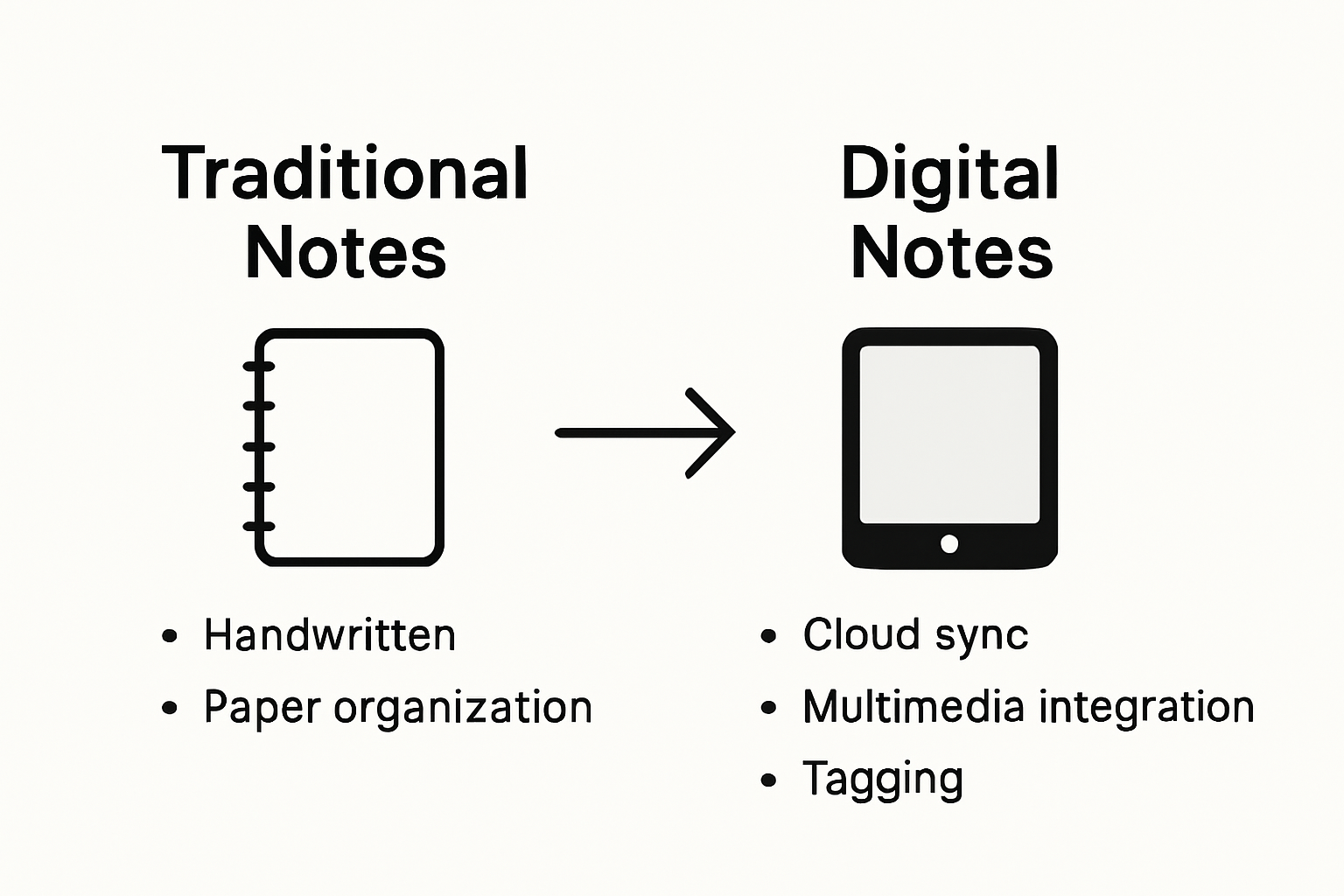
Multimedia integration sets digital note-taking apart from traditional methods. Users can now embed audio recordings, images, web links, and interactive elements directly into their notes, creating rich, contextual learning experiences impossible with pen and paper. This multi-modal approach supports diverse learning styles, allowing visual learners to incorporate diagrams, auditory learners to include recordings, and kinesthetic learners to add interactive elements that enhance comprehension and retention.
The collaborative potential of digital note-taking represents perhaps its most transformative benefit. Unlike traditional notes that remain isolated and personal, digital platforms enable real-time sharing, collaborative editing, and instant knowledge distribution. Students can simultaneously contribute to group projects, researchers can share insights across global networks, and professionals can create living documents that evolve through collective intelligence. By breaking down physical and geographical barriers, digital note-taking transforms information from a solitary experience into a dynamic, interconnected ecosystem of shared knowledge.
Common Missteps and How to Avoid Them
Digital note-taking requires strategic approach to maximize effectiveness. Mobile device annotation challenges demonstrate significant obstacles that users must carefully navigate. Many individuals make fundamental errors that compromise their note-taking efficiency, ranging from poor organization to inconsistent capture strategies that ultimately undermine knowledge retention and productivity.
One critical misstep involves over-relying on default application settings without customizing them to personal learning or working styles. Users frequently fail to explore advanced features that could dramatically improve their note-taking experience. Innovative solutions like gaze-assisted voice note-taking suggest that technology can adapt to individual preferences, but users must actively engage with these capabilities rather than passively accepting standard configurations.
Practical challenges emerge in dynamic work environments, particularly during mobile scenarios. Research on note-taking during walking meetings highlights the complexity of capturing information while in motion. Common mistakes include attempting to type extensively on small screens, neglecting context-specific note organization, and failing to use cross-platform synchronization tools that enable seamless information transfer across devices.
To avoid these pitfalls, digital note-takers should implement a systematic approach. Develop a consistent tagging system, leverage voice-to-text technologies, regularly review and clean up digital notes, and choose platforms with robust search and integration capabilities. Recognize that digital note-taking is a skill that requires continuous learning and adaptation, not just a technical tool. By approaching these platforms with intentionality and a willingness to experiment, users can transform potential obstacles into opportunities for more effective knowledge management.
Empower Smarter Learning with AI-Powered Summaries
The article highlights how digital note-taking transforms information capture but also shows the challenges of managing vast knowledge efficiently. If you struggle to organize lecture videos, webinars, or lengthy tutorials, or want to avoid common pitfalls like missing key points while taking notes, SummYT offers a powerful solution. By combining intelligent summarization with seamless access, SummYT saves you time and helps you retain the most important insights from video content.

Experience the future of digital note-taking through effortless video summaries. Whether you are a student seeking quick comprehension of complex lectures or a professional wanting streamlined webinar notes, SummYT’s AI-driven platform lets you capture the essence of any video in minutes instead of hours. Start improving your productivity and learning today with SummYT’s YouTube summarizer. Discover how easy it is to stay focused on what matters with SummYT and never miss a key insight again.
Frequently Asked Questions
What is digital note-taking?
Digital note-taking is a modern approach to capturing and organizing information using digital tools, allowing dynamic interaction with content through searchability, multimedia integration, and cloud synchronization.
How does digital note-taking enhance learning?
Digital note-taking enhances learning by providing flexible and interactive tools for information capture, allowing for real-time collaboration, cross-device access, and the integration of various media formats that cater to different learning styles.
What are popular digital note-taking tools?
Popular digital note-taking tools include Microsoft OneNote, Evernote, Roam Research, and Obsidian, each offering unique features for information organization and retrieval.
What are some common mistakes to avoid when digital note-taking?
Common mistakes include neglecting to customize note-taking applications to fit personal workflows, failing to create a consistent tagging system, and overlooking advanced features that enhance note organization and retrieval.
Recommended
- Digital Note-Taking Tips: Boost Learning and Productivity
- Digital Note-Taking Explained: Boosting Learning and Focus
- Digital Note-Taking Explained: Boosting Learning and Focus
- Digital Note-Taking Tips: Boost Learning and Productivity
- 7 Best Study Gadgets for Students to Boost Learning Power - Projector Display