Importance of Review Summaries: Complete Guide


Most people spend nearly a third of their reading time just sifting through background details and extra information. In a world where knowledge doubles every few years, knowing how to cut through the noise has become a critical skill. Understanding review summaries can save hours and sharpen focus, making it easier to extract key insights from dense material and stay ahead in both academic and professional pursuits.
Table of Contents
- Defining Review Summaries And Their Purpose
- Key Types Of Review Summaries Explained
- How Review Summaries Enhance Learning Efficiency
- Applications Across Professional And Academic Fields
- Risks, Limitations, And Common Missteps
Key Takeaways
| Point | Details |
|---|---|
| Definition of Review Summaries | Review summaries are concise representations that distill complex material into essential ideas without personal interpretation, facilitating quick comprehension. |
| Types of Review Summaries | Different types, including narrative reviews, systematic reviews, and meta-analyses, each serve distinct academic and professional purposes for information synthesis. |
| Enhancing Learning Efficiency | Review summaries boost learning by condensing information, reducing cognitive load, and reinforcing memory through structured insights, turning passive consumption into active engagement. |
| Risks and Limitations | Missteps in creating review summaries can lead to bias, oversimplification, and misrepresentation, highlighting the need for objectivity and thorough verification in summarization practices. |
Defining Review Summaries and Their Purpose
A review summary is a concise, objective representation of source material that distills complex content into its essential ideas and core insights. According to writingcommons.org, review summaries are designed to convey main ideas and organizational structures without introducing personal interpretation, enabling readers to quickly understand the fundamental components of a text.
Review summaries serve multiple critical purposes across various domains:
- Provide rapid comprehension of complex material
- Capture key arguments and methodological approaches
- Enable efficient research and information processing
- Facilitate knowledge transfer without requiring full source material review
Academic research offers a sophisticated perspective on review summaries. As Wikipedia explains, a review article synthesizes the current state of understanding within a specific discipline by analyzing and discussing methods and conclusions from previously published studies. This approach transforms individual research pieces into a comprehensive narrative that reveals broader patterns, trends, and potential research gaps.
Understanding review summaries is not just an academic exercise. In today’s information-saturated world, the ability to quickly extract and communicate core insights has become an essential skill for professionals, researchers, students, and lifelong learners. By mastering the art of creating and interpreting review summaries, individuals can dramatically improve their learning efficiency and knowledge retention. For those seeking to enhance their summary skills, our guide on understanding why concise summaries matter provides additional strategies and techniques.
Key Types of Review Summaries Explained
Review summaries are not one-size-fits-all. According to Lane Guides, there are distinct types of review summaries, each serving unique research and communication objectives. Narrative reviews, systematic reviews, and meta-analyses represent the primary categories of review summaries, each offering different approaches to synthesizing and presenting information.
Narrative Reviews:
- Provide qualitative, descriptive overviews of a topic
- Less structured and more interpretive
- Ideal for exploring broad concepts and theoretical frameworks
- Often used in humanities and social sciences
According to Wikipedia, systematic reviews represent a more rigorous approach to summarizing research. These comprehensive analyses use structured methodologies to:
- Identify relevant studies
- Define specific selection criteria
- Critically assess research literature
- Synthesize findings on a specific topic
Meta-analyses take systematic review techniques a step further by statistically combining quantitative data from multiple studies.
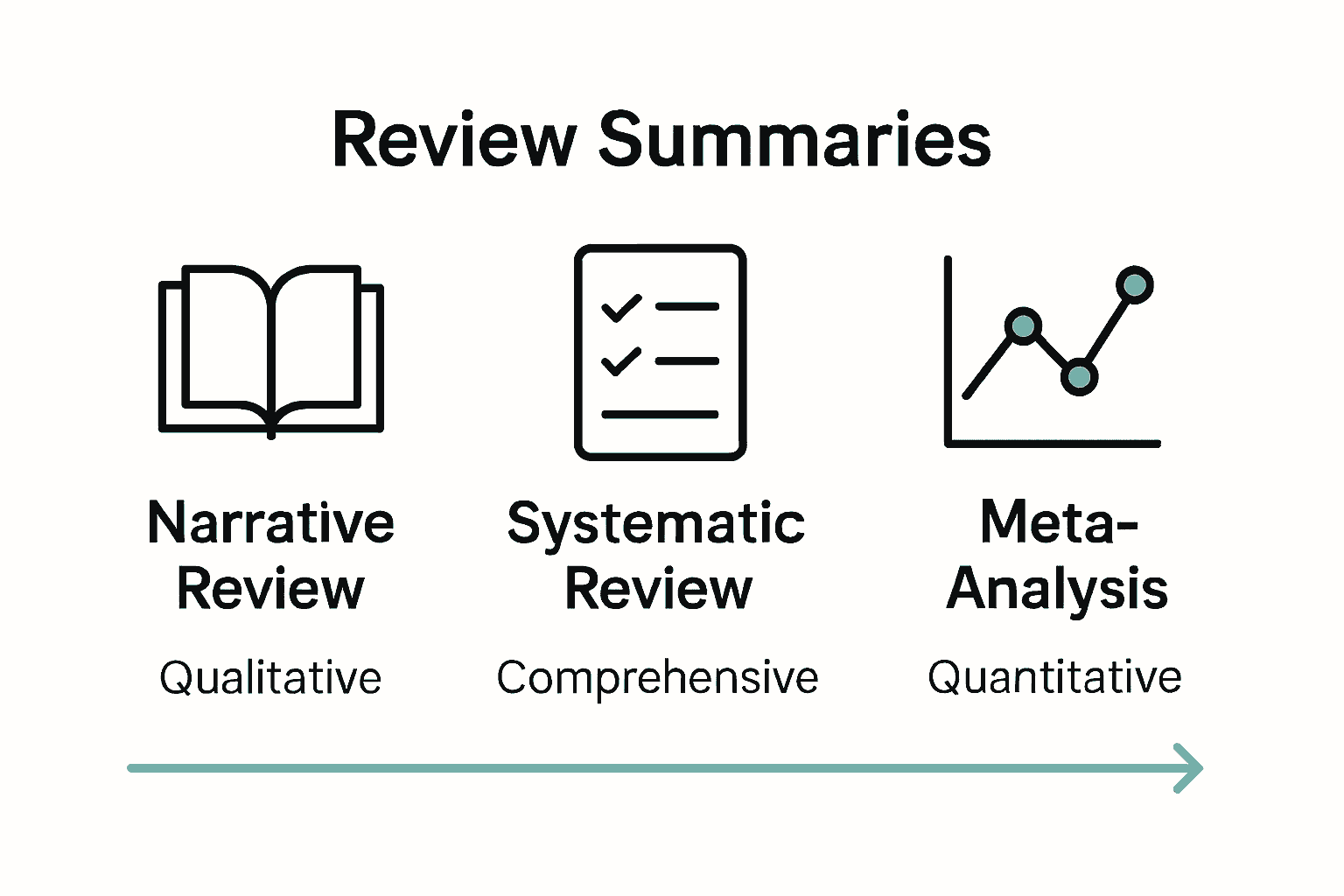
This approach allows researchers to draw more powerful conclusions by aggregating results across different research projects.
Each review summary type offers unique advantages, and understanding their distinct characteristics helps researchers and professionals choose the most appropriate approach for their specific needs.

For those interested in diving deeper into content summarization techniques, our 7 Types of Content Summaries You Need to Know article provides additional insights into various summarization strategies.
How Review Summaries Enhance Learning Efficiency
Learning is fundamentally about efficiency, and review summaries are powerful tools that transform how we absorb and retain information. According to Writing Commons, review summaries distill complex information into concise formats, enabling readers to quickly grasp essential concepts and main ideas, thereby significantly enhancing comprehension and retention.
Key ways review summaries boost learning efficiency include:
- Rapid Information Processing: Condense hours of content into minutes
- Cognitive Load Reduction: Minimize mental strain by presenting core insights
- Selective Focus: Highlight critical information and key takeaways
- Memory Reinforcement: Create structured mental frameworks for better recall
Wikipedia explains that condensed document versions allow readers to become rapidly acquainted with large bodies of material without reading them entirely. This approach is particularly valuable in academic, professional, and personal learning contexts where time and mental energy are precious resources.
The learning efficiency gains from review summaries extend beyond simple time-saving. They transform passive consumption into active engagement, helping learners develop critical thinking skills by forcing them to identify and synthesize core ideas. For students, professionals, and lifelong learners alike, mastering the art of creating and utilizing review summaries can dramatically accelerate knowledge acquisition.
Those looking to dive deeper into effective summarization techniques can explore our 7 Effective Ways to Summarize Lectures for Better Retention guide, which offers practical strategies for maximizing learning potential.
Applications Across Professional and Academic Fields
Review summaries are versatile tools that transcend traditional boundaries, proving invaluable across diverse professional and academic domains. Wikipedia highlights their critical role in academia, where review articles synthesize existing research to provide comprehensive overviews of specific topics, helping researchers understand current knowledge and identify critical gaps for future investigations.
Key applications of review summaries include:
Academic Fields:
- Scientific research literature reviews
- Medical and clinical research assessments
- Comprehensive literature analyses in humanities
- Interdisciplinary knowledge integration
Professional Contexts:
- Corporate Strategy: Condensing market research reports
- Finance: Summarizing investment analyses
- Healthcare: Reviewing patient treatment protocols
- Technology: Assessing emerging industry trends
In professional environments, Wikipedia explains that executive summaries enable stakeholders to make informed decisions by presenting key information from detailed reports without requiring exhaustive document review. This approach dramatically reduces time investment while maintaining critical information accessibility.
The power of review summaries lies in their ability to transform complex, extensive information into digestible insights across disciplines. Researchers, executives, and professionals can leverage these summaries to quickly grasp nuanced concepts, track developments, and make strategic decisions. For professionals seeking to enhance their summarization skills, our Role of Summaries in Education: Complete Guide provides comprehensive strategies for effective information synthesis.
Risks, Limitations, and Common Missteps
Review summaries, while powerful, are not infallible tools. According to Writing Commons, common missteps in creating review summaries include introducing personal interpretations, omitting key information, and failing to accurately represent the original text—risks that can lead to significant misunderstandings and potentially misinformed decisions.
Common Pitfalls in Review Summaries:
- Bias Introduction: Unconsciously inserting personal perspectives
- Information Truncation: Removing critical contextual details
- Oversimplification: Reducing complex ideas to superficial statements
- Source Misrepresentation: Distorting original research intent
Wikipedia further highlights significant limitations in review articles, noting potential risks such as:
- Inherent biases in study selection and interpretation
- Risk of perpetuating errors from original research
- Possibility of overlooking recent developments
- Potential for incomplete or outdated information
Professionals and researchers must approach review summaries with critical awareness, recognizing that these tools are meant to enhance understanding, not replace comprehensive research. Maintaining objectivity, ensuring thorough source verification, and regularly updating summaries are crucial strategies for mitigating these inherent risks. For those seeking to develop more robust summarization skills, our 7 Effective Ways to Summarize Lectures for Better Retention guide offers practical techniques for creating more accurate and reliable summaries.
Boost Your Learning Efficiency with AI-Powered Review Summaries
The challenge of distilling lengthy, complex content into clear, concise ideas is at the heart of mastering review summaries. This article highlights how important it is to capture key insights without losing essential information — a task that can feel overwhelming when faced with hours of video lectures or webinars. If you want to save time while ensuring you never miss critical points, an effective solution is crucial.
Discover how SummYT can transform your video-based learning by automatically creating precise summaries and essential takeaways from any YouTube video. Whether you are a student needing quick comprehension, a professional pressed for time, or a lifelong learner aiming to clear your watch list, SummYT streamlines the process, removing distractions and helping you focus on what truly matters. Start using SummYT today to unlock faster understanding and better retention from your favorite educational content. Visit SummYT now and experience the power of AI-driven summarization for yourself.
Frequently Asked Questions
What is a review summary?
A review summary is a concise representation of complex content, highlighting the essential ideas and core insights of the source material without personal interpretation.
What are the main types of review summaries?
The main types of review summaries are narrative reviews, systematic reviews, and meta-analyses. Each serves different research and communication objectives.
How do review summaries enhance learning efficiency?
Review summaries enhance learning efficiency by condensing information, reducing cognitive load, highlighting key takeaways, and reinforcing memory retention, allowing learners to grasp essential concepts quickly.
What are some common pitfalls when creating review summaries?
Common pitfalls include introducing personal bias, omitting key information, oversimplifying complex ideas, and misrepresenting the original source, which can lead to misunderstandings and misinformed decisions.