Content Summarization: Boosting Learning Efficiency Fast


Every American professional or student faces a flood of information daily, yet research shows that people retain just 20 percent of what they read or hear. With time at a premium in busy American workplaces, finding ways to quickly grasp critical insights can set you apart. This guide explains how content summarization distills complex materials into clear, efficient takeaways so you can learn faster and make smarter choices.
Table of Contents
- Content Summarization Defined And How It Works
- Types Of Content Summarization Approaches
- Key Benefits For Learners And Professionals
- Common Challenges And Accuracy Issues
- Tools And AI Solutions For Summarization
Key Takeaways
| Point | Details |
|---|---|
| Content Summarization Enhances Efficiency | Summarization tools significantly reduce the time needed to process information, allowing professionals and students to quickly extract essential insights from extensive content. |
| Two Main Approaches | Content summarization primarily employs extractive and abstractive methods, each tailored to convert complex information into digestible formats efficiently. |
| Technological Advancements | Modern AI-driven summarization techniques improve accuracy and contextual understanding, making information extraction more reliable and effective. |
| Challenges Remain | Despite advancements, challenges such as maintaining semantic coherence and contextual nuances continue to impact the accuracy of summarization technologies. |
Content Summarization Defined And How It Works
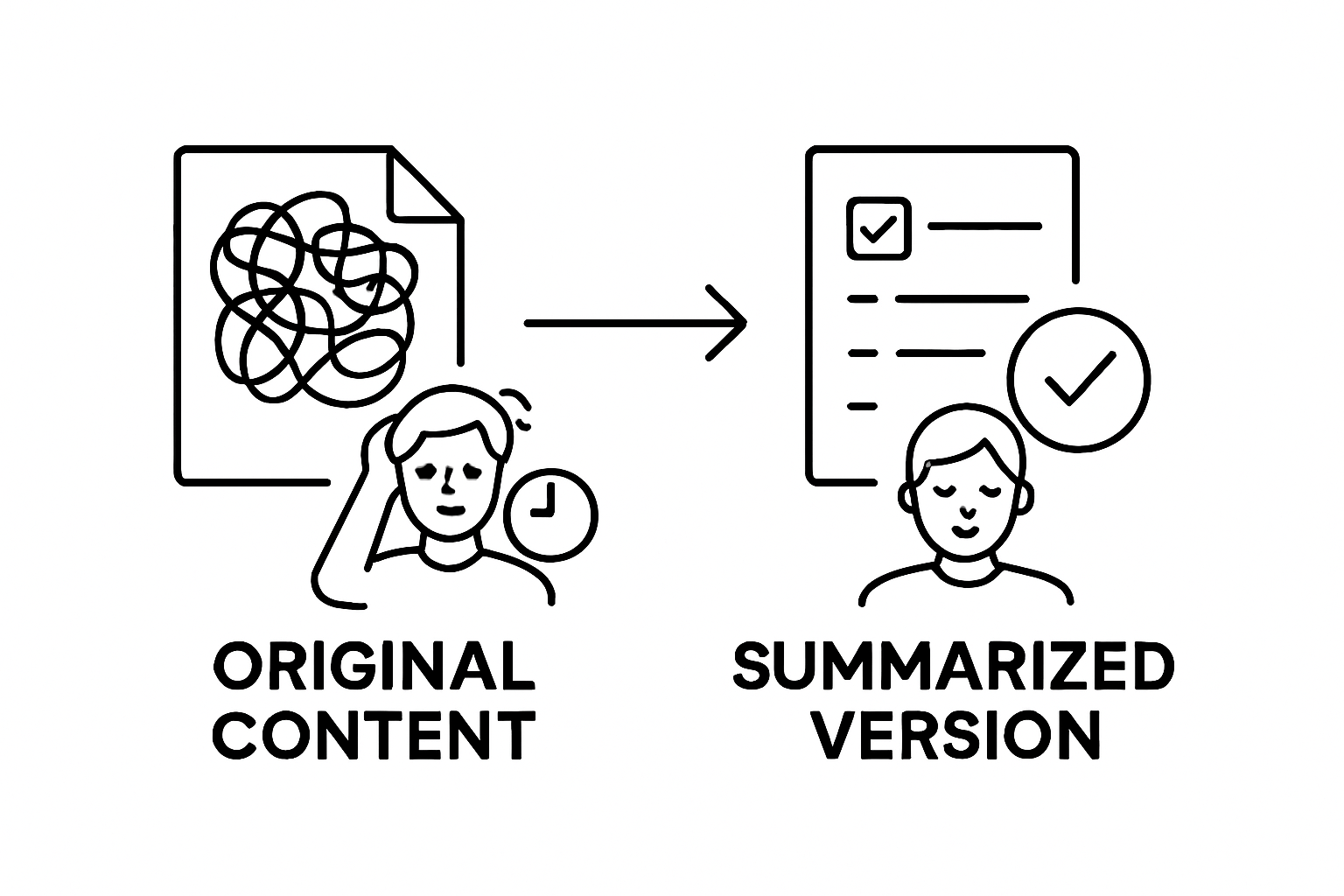
Content summarization transforms extensive information into concise, digestible insights by extracting the most critical elements from original text or media. This strategic process allows knowledge workers to rapidly understand complex subjects without consuming hours of original content. Modern summarization techniques leverage advanced artificial intelligence and natural language processing to rapidly analyze, comprehend, and condense information.
At its core, content summarization involves multiple sophisticated techniques. These include extractive summarization, which identifies and preserves the most significant sentences from the original text, and abstractive summarization, which generates entirely new sentences that capture the core meaning. Advanced AI models like ConceptEVA introduce mixed-initiative approaches for generating and evaluating summaries, enabling more nuanced and contextually accurate representations of complex documents.
The practical applications of content summarization span numerous professional domains. Research indicates these tools can significantly enhance decision-making by distilling critical information from various sources like URLs, PDFs, and articles. Knowledge workers, researchers, journalists, and students can leverage summarization to:
- Quickly extract key insights from lengthy documents
- Reduce time spent consuming original content
- Improve information retention and comprehension
- Facilitate faster research and analysis
Successful content summarization requires sophisticated algorithms capable of understanding context, recognizing semantic relationships, and preserving the original message’s essential meaning. By intelligently filtering out redundant information and highlighting core concepts, these tools transform how professionals interact with complex informational resources.
Types Of Content Summarization Approaches
Content summarization encompasses multiple sophisticated approaches, each designed to extract and represent critical information efficiently. The two primary methodologies are extractive and abstractive summarization, which offer distinct mechanisms for transforming complex content into concise insights. Advanced AI models leverage multi-task encoder-decoder systems to generate nuanced summaries, enabling more intelligent information processing across diverse document types.

Extractive summarization represents the traditional approach, where algorithms identify and extract the most significant sentences directly from the original text. This method preserves the original language and ensures high fidelity to the source material. In contrast, abstractive summarization generates entirely new sentences that capture the core meaning, potentially rephrasing and restructuring information to create more coherent and condensed representations.
Modern summarization techniques integrate multiple technologies like Large Language Models (LLMs), Natural Language Processing (NLP), and vector databases to enhance information extraction. The emerging hybrid approaches combine extractive and abstractive methods to deliver more comprehensive summaries. These advanced techniques enable professionals to rapidly understand complex documents by:
- Preserving semantic relationships between concepts
- Maintaining contextual accuracy
- Reducing redundant information
- Generating human-readable summaries
These sophisticated summarization approaches are transforming how knowledge workers consume and process information, offering unprecedented efficiency in research, learning, and professional development. By intelligently distilling vast amounts of content into precise, meaningful insights, content summarization technologies are becoming essential tools in our information-rich world.
Key Benefits For Learners And Professionals
Content summarization technologies offer transformative advantages for learners and professionals seeking efficient knowledge acquisition. Advanced summarization tools enhance accessibility to vast data repositories, promoting informed decision-making across multiple domains, enabling users to rapidly process complex information without becoming overwhelmed by excessive details.
For students and academic researchers, these tools dramatically accelerate learning processes. They can quickly extract critical insights from lengthy academic papers, lectures, and research materials, reducing study time while maintaining comprehensive understanding. Professionals in fields like finance, technology, and journalism benefit similarly by accessing condensed yet comprehensive information that supports faster strategic planning and research.
Summarization technologies save significant time and enhance decision-making by distilling critical information across various professional contexts. The key benefits for learners and professionals include:
- Rapid comprehension of complex topics
- Reduced time spent consuming original content
- Improved information retention
- Enhanced research efficiency
- Streamlined knowledge management
- Increased productivity across learning and professional environments
These intelligent summarization approaches represent a significant leap in how individuals interact with information. By transforming overwhelming content into digestible insights, these technologies empower users to stay informed, make faster decisions, and continuously expand their knowledge without being constrained by time-consuming traditional research methods.
Common Challenges And Accuracy Issues
Content summarization technologies face significant challenges in maintaining precise and contextually accurate representations of complex information. Advanced AI models struggle with incorporating critical nuances and comprehensive critiques into generated summaries, revealing inherent limitations in current automated summarization approaches.
The primary accuracy challenges stem from the intricate nature of language comprehension and context preservation. Summarization algorithms must navigate multiple complex tasks simultaneously: identifying key information, maintaining semantic integrity, and presenting condensed insights without losing critical meaning. Some fundamental issues include semantic drift, where summaries gradually deviate from the original content’s core message, and contextual misinterpretation that can fundamentally alter the intended communication.
Navigating complex documents and generating precise, actionable insights remains a significant technological challenge for summarization tools. The most prominent accuracy challenges include:
- Preserving subtle contextual nuances
- Maintaining semantic coherence
- Avoiding information distortion
- Handling domain-specific technical language
- Managing complex argumentative structures
- Preventing unintended bias introduction
As artificial intelligence continues to evolve, researchers and developers are working to address these fundamental challenges. By developing more sophisticated natural language processing algorithms and implementing advanced machine learning techniques, the goal is to create summarization tools that can more accurately capture the depth and complexity of human communication.
Tools And AI Solutions For Summarization
Modern content summarization relies on sophisticated artificial intelligence technologies that transform how we process and understand complex information. ConceptEVA represents a groundbreaking mixed-initiative approach for generating, evaluating, and customizing summaries across diverse document types, showcasing the incredible potential of advanced AI in information distillation.
The landscape of summarization tools encompasses various sophisticated technologies, including natural language processing (NLP), machine learning algorithms, and advanced neural networks. These intelligent systems analyze text through multiple layers of semantic understanding, extracting key concepts, identifying critical relationships, and reconstructing information in concise, meaningful formats. By leveraging deep learning techniques, these tools can now handle increasingly complex documents with remarkable precision.
Contemporary summarization solutions demonstrate remarkable capabilities in processing multiple content formats, including URLs, PDFs, and complex articles. The most advanced AI summarization technologies offer:
- Multilingual processing capabilities
- Context-aware content extraction
- Adaptive summarization techniques
- Customizable output formats
- Real-time processing
- Semantic relationship mapping
As artificial intelligence continues to evolve, summarization tools are becoming increasingly sophisticated, transforming how professionals and learners interact with complex information. These intelligent systems represent a critical technological advancement, enabling faster comprehension, more efficient research, and enhanced knowledge management across various domains.
Unlock Faster Learning with AI-Powered Video Summaries
The article highlights the challenge of quickly grasping complex content without losing critical context or spending hours consuming original material. If you are a student, professional, or lifelong learner overwhelmed by lengthy videos and looking to improve knowledge retention and research efficiency, content summarization is the key. Techniques like extractive and abstractive summarization help distill essential insights and eliminate redundant information, but leveraging cutting-edge AI tools can take your learning even further.

Experience how SummYT revolutionizes video-based learning by automatically creating clear, concise summaries and key takeaways from any YouTube video. Whether it’s lectures, tutorials, or webinars, SummYT saves you time while enhancing comprehension so you can focus on what truly matters. Start transforming your workflow with unlimited summaries, multilingual support, and browser extensions designed for instant access. Don’t let long videos slow your progress. Visit SummYT today and empower your learning with fast, AI-driven content summarization.
Frequently Asked Questions
What is content summarization?
Content summarization is the process of transforming extensive information into concise, digestible insights by extracting critical elements from original text or media, enabling quicker understanding of complex subjects.
How does extractive summarization differ from abstractive summarization?
Extractive summarization identifies and preserves significant sentences from the original text, while abstractive summarization generates entirely new sentences that capture the core meaning, potentially rephrasing and restructuring the information.
What are the key benefits of content summarization for learners and professionals?
Key benefits include rapid comprehension of complex topics, reduced time spent on original content, improved information retention, enhanced research efficiency, and increased productivity in both learning and professional environments.
What challenges do summarization tools face in maintaining accuracy?
Summarization tools face challenges such as preserving subtle contextual nuances, maintaining semantic coherence, avoiding information distortion, and handling complex argumentative structures that could alter the intended communication.