AI-Powered Educational Tools: Transforming Study Practices


Over one billion educational videos are uploaded annually, making rapid comprehension essential for busy American university students and researchers. Navigating massive online content libraries is a common struggle worldwide, where quick access to summarized information can make or break efficient study sessions. This overview reveals how AI-powered educational tools are reshaping learning by delivering personalized video summaries, adaptive content, and instant feedback for anyone aiming to master material faster than ever before.
Table of Contents
- Defining AI-Powered Educational Tools
- Types of AI Tools for Efficient Learning
- How AI Summarizes Educational Videos
- Benefits for Students and Researchers
- Privacy, Accuracy, and Usage Concerns
Key Takeaways
| Point | Details |
|---|---|
| AI-Powered Tools Enhance Learning | AI-powered educational tools provide personalized learning experiences that adapt to individual student needs, transforming traditional academic methodologies. |
| Diverse Categories of AI Tools | The landscape of AI learning tools includes Intelligent Tutoring Systems, Adaptive Learning Platforms, Automated Grading Tools, and Generative AI Content Creators, each offering unique benefits for academic success. |
| AI Video Summarization Advantages | AI-driven video summarization efficiently distills long educational videos into concise, meaningful summaries, making learning more accessible and efficient. |
| Addressing Privacy and Accuracy Concerns | As AI tools become widespread, it is crucial to address privacy issues, algorithmic biases, and the importance of maintaining critical thinking when utilizing these technologies. |
Defining AI-Powered Educational Tools
AI-powered educational tools represent cutting-edge technological solutions designed to transform traditional learning experiences through intelligent, adaptive systems. These advanced platforms utilize machine learning algorithms and artificial intelligence to personalize educational content, automate assessment processes, and provide dynamic learning support. Advanced technological innovations in educational contexts are rapidly changing how students interact with academic materials.
The core characteristics of AI-powered educational tools include adaptive learning capabilities, intelligent tutoring systems, and personalized content delivery. Unlike traditional educational resources, these tools dynamically adjust to individual student performance, learning styles, and comprehension levels. They can analyze student interactions in real-time, identify knowledge gaps, and recommend targeted learning interventions. Virtual pedagogical agents embedded within these platforms offer personalized guidance, answer questions, and provide immediate feedback that traditional classroom settings cannot match.
Key technological components of AI-powered educational tools typically encompass several sophisticated mechanisms:
- Machine learning algorithms for performance prediction
- Natural language processing for interactive learning experiences
- Data analytics for tracking student progress
- Adaptive assessment techniques
- Intelligent content recommendation systems
These tools are not merely technological add-ons but represent a fundamental shift in educational methodology, enabling more responsive, individualized learning experiences across academic disciplines.
Pro Study Strategy: Integrate AI-powered educational tools systematically into your study routine by first understanding their unique features and gradually incorporating them into your learning workflow to maximize their personalized learning potential.
Types of AI Tools for Efficient Learning
AI learning tools represent a diverse ecosystem of technological solutions designed to enhance educational experiences across multiple dimensions. Systematic comparative analyses of AI learning tools reveal several critical categories that transform traditional academic practices. These tools range from intelligent tutoring systems to advanced adaptive learning platforms, each addressing unique aspects of student engagement and knowledge acquisition.
Four primary categories of AI educational tools dominate contemporary learning environments:
- Intelligent Tutoring Systems: Provide personalized learning pathways and real-time feedback
- Adaptive Learning Platforms: Dynamically adjust content difficulty based on student performance
- Automated Grading Tools: Streamline assessment processes with machine learning algorithms
- Generative AI Content Creators: Generate study materials, practice questions, and explanatory content
Each category offers distinct advantages in supporting academic growth. Comprehensive reviews of AI tools in higher education highlight their potential to revolutionize learning by addressing individual student needs through sophisticated technological interventions. These tools analyze learning patterns, predict potential knowledge gaps, and provide targeted interventions that traditional educational methods cannot replicate.
Here’s a comparison of the main AI tool categories and their unique contributions to learning:
| Tool Category | Core Function | Typical Users | Academic Impact |
|---|---|---|---|
| Intelligent Tutoring Systems | Tailored feedback pathways | K-12, undergrads | Boosts engagement, retention |
| Adaptive Learning Platforms | Level-adjusted content | All students | Closes learning gaps quickly |
| Automated Grading Tools | Fast, objective evaluations | Teachers | Reduces admin workload |
| Generative AI Content Creators | Custom study materials | Students, tutors | Supports creative understanding |
The technological sophistication of these AI tools extends beyond simple automation. They integrate advanced machine learning algorithms, natural language processing, and adaptive cognitive modeling to create truly personalized learning experiences. By analyzing student interactions, performance metrics, and learning styles, these tools can generate uniquely tailored educational content that maximizes comprehension and retention.

Pro Study Strategy: Experiment with different AI learning tools systematically, starting with one category, to discover which technological approach best complements your individual learning style and academic objectives.
How AI Summarizes Educational Videos
AI-driven video summarization represents a sophisticated technological process that transforms lengthy educational content into concise, digestible insights. Advanced video summarization techniques involve complex computational methods that break down video content into meaningful segments, extracting the most relevant information through intelligent analysis. These systems go beyond simple text extraction, employing advanced algorithms to understand context, identify key concepts, and generate comprehensive summaries.
The summarization process typically involves multiple sophisticated stages:
- Content Segmentation: Dividing videos into logical topical sections
- Key Concept Extraction: Identifying primary themes and critical information
- Semantic Analysis: Understanding contextual relationships between ideas
- Multimodal Processing: Integrating visual, audio, and textual information
- Summary Generation: Creating concise representations of the original content
Comprehensive reviews of video summarization workflows reveal two primary approaches to AI-powered video summarization: extractive and abstractive methods. Extractive techniques select and compile existing segments from the original video, while abstractive methods generate entirely new summaries that capture the essence of the content. These approaches leverage deep learning models, natural language processing, and advanced machine learning algorithms to create increasingly sophisticated and accurate summaries.
The table below summarizes the distinctions between extractive and abstractive video summarization approaches:
| Summarization Approach | Summary Generation Method | Strength | Limitation |
|---|---|---|---|
| Extractive | Selects key original video clips | High factual fidelity | May lack context clarity |
| Abstractive | Rewrites main ideas in new form | Better context capture | Possible detail omission |
The technological complexity of AI video summarization extends far beyond simple text extraction. Intelligent systems analyze multiple dimensions of video content, including speaker tone, visual cues, graphic elements, and semantic context. By processing these multifaceted inputs, AI tools can generate summaries that capture not just the literal content, but the underlying educational significance and key learning objectives of the original material.
Pro Study Strategy: Experiment with different AI video summarization tools to understand their unique strengths, comparing their outputs across various educational video types to find the most effective approach for your specific learning needs.
Benefits for Students and Researchers
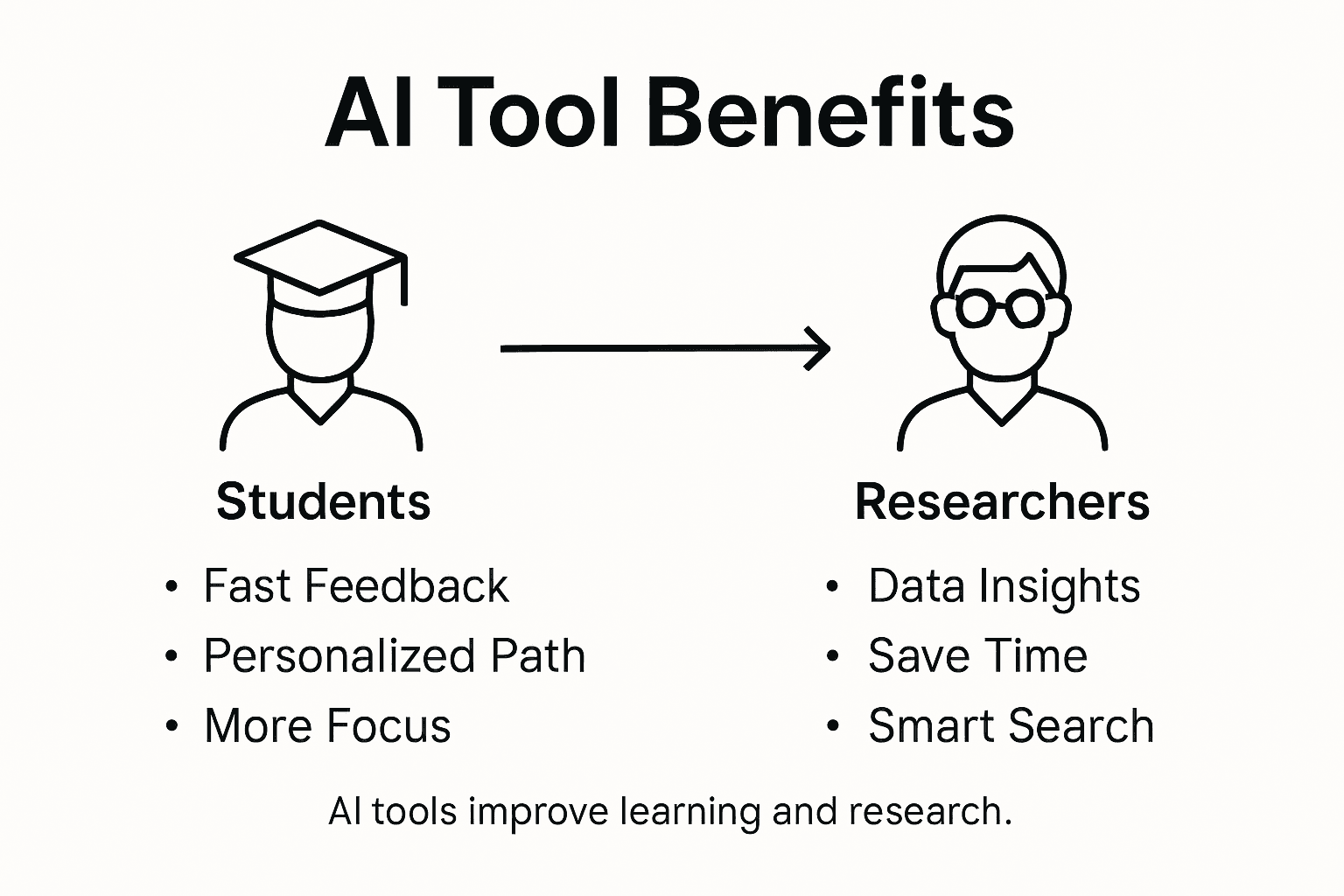
AI-powered educational tools are revolutionizing academic workflows by providing unprecedented support for both students and researchers across multiple dimensions of learning and knowledge creation. Systematic global research on AI tool benefits reveals transformative impacts that extend far beyond traditional educational technologies. These intelligent systems are fundamentally reshaping how academic work is conceptualized, executed, and analyzed.
Key benefits for students include:
- Personalized Learning Pathways: Adaptive content tailored to individual learning styles
- Instant Comprehension Support: Real-time explanations and context clarification
- Efficient Study Optimization: Targeted resource recommendations
- Performance Analytics: Detailed insights into learning progress and knowledge gaps
- Motivation Enhancement: Interactive and engaging learning experiences
Researchers experience equally significant advantages through AI-powered tools. These technologies streamline complex research processes by automating time-consuming tasks such as literature review, data analysis, and manuscript preparation. Advanced natural language processing enables researchers to quickly synthesize large volumes of academic content, identify research trends, and generate comprehensive literature summaries with unprecedented speed and accuracy.
The technological sophistication of these tools extends beyond simple task automation. Intelligent systems can now provide nuanced insights, predict potential research directions, and offer contextual recommendations that amplify human analytical capabilities. By integrating machine learning algorithms with domain-specific knowledge, AI tools create a collaborative ecosystem that enhances intellectual productivity and expands the boundaries of academic exploration.
Pro Study Strategy: Regularly experiment with different AI research and learning tools, systematically documenting their effectiveness for your specific academic objectives to develop a personalized technological support strategy.
Privacy, Accuracy, and Usage Concerns
As AI-powered educational technologies become increasingly prevalent, critical questions emerge regarding their ethical implementation, data management, and potential societal impacts. University students’ privacy concerns with generative AI tools reveal complex challenges surrounding data protection, personal information security, and potential psychological implications of widespread technological adoption.
Key privacy and usage concerns include:
- Data Collection Transparency: Understanding what personal information is gathered
- Algorithmic Bias: Identifying potential discriminatory patterns in AI systems
- Consent Mechanisms: Ensuring voluntary and informed user participation
- Data Security: Protecting sensitive academic and personal information
- Intellectual Property Rights: Clarifying ownership of generated content
Global policy recommendations for educational technology emphasize the importance of developing robust governance frameworks that balance technological innovation with fundamental human rights. These guidelines address the critical need for comprehensive regulatory approaches that protect student interests while enabling technological advancement.
The accuracy of AI educational tools presents another significant challenge. While these technologies offer unprecedented capabilities, they are not infallible. Researchers and students must maintain critical thinking skills, independently verifying AI-generated information and understanding the limitations of algorithmic analysis. The most effective approach involves viewing AI tools as collaborative partners rather than absolute authorities, leveraging their strengths while maintaining human oversight and intellectual independence.
Pro Privacy Strategy: Carefully review the privacy settings and data usage policies of any AI educational tool before integration, maintaining a proactive approach to protecting your personal and academic information.
Maximize Your Learning Efficiency with AI-Powered Video Summaries
The article highlights how AI-powered educational tools transform study habits by offering personalized learning, instant comprehension support, and efficient study optimization. One common challenge students and researchers face is the overwhelming time commitment required to watch long educational videos. This is where AI video summarization shines by creating concise, meaningful overviews that let you absorb key concepts without the lengthy watch time.

Discover how SummYT addresses this challenge directly by automatically generating clear, concise summaries and key insights from any YouTube educational video—lectures, tutorials, webinars, or podcasts. With SummYT’s AI-driven summarization, you can save precious study time, reinforce your subject understanding with personalized insights, and stay ahead without sacrificing hours. Start transforming your study routine now with SummYT and experience streamlined, productive video-based learning tailored to your needs.
Explore the future of learning at SummYT and make every minute of your study time count.
Frequently Asked Questions
What are AI-powered educational tools?
AI-powered educational tools are advanced technological solutions that use artificial intelligence to improve learning experiences. They personalize content, automate assessments, and provide dynamic support to students, adapting to individual learning styles and performance levels.
How do intelligent tutoring systems work?
Intelligent tutoring systems offer personalized learning pathways by analyzing student interactions in real-time. They provide tailored feedback and adaptive learning resources to help students understand concepts better and improve their performance.
What are the benefits of using AI learning tools for students?
AI learning tools provide numerous benefits, including personalized learning pathways, instant comprehension support, efficient study optimization, detailed performance analytics, and enhanced motivation through engaging interactions.
What privacy concerns should users be aware of when using AI educational tools?
Users should be aware of several privacy concerns, including data collection transparency, algorithmic bias, consent mechanisms, data security, and intellectual property rights. It is crucial to review the privacy settings and data usage policies of these tools before use.