Machine Learning Summaries: Transforming Video Study


Over 60 percent of American university students now prefer educational videos for complex topics, but sorting through endless hours can waste valuable study time. Fast, accurate understanding is critical for global researchers and students balancing dense workloads. This article explores how machine learning summaries make online video resources far more accessible, revealing what these advanced tools can really do and where their biggest challenges lie.
Table of Contents
- Machine Learning Summaries Defined and Debunked
- Techniques Powering Video Summarization Today
- Key Features: Multilingual, Fast, and Accurate Output
- Real-World Uses for Students and Researchers
- Practical Challenges and How to Overcome Them
Key Takeaways
| Point | Details |
|---|---|
| Machine Learning Summaries Enhance Efficiency | These systems rapidly analyze and condense video content, enabling quicker information processing for students and researchers. |
| Extractive and Abstractive Techniques Offer Flexibility | Users can choose between selecting key segments or generating new summaries, depending on their specific needs. |
| Be Aware of Limitations | Despite advancements, machine learning models can misinterpret nuanced content, necessitating cross-referencing with original sources. |
| Multilingual Capabilities Expand Accessibility | Modern summarization technologies provide contextually accurate summaries across languages, breaking down communication barriers. |
Machine Learning Summaries Defined and Debunked
Machine learning summaries represent sophisticated computational techniques designed to transform video content into concise, meaningful representations without manual human intervention. These advanced algorithms leverage deep learning models to analyze, extract, and synthesize key information from complex video sources. Analyzing video summarization techniques reveals a nuanced landscape of extractive and abstractive strategies that go far beyond simple text reduction.
Unlike traditional summarization methods, machine learning approaches dynamically interpret video content through multiple layers of neural networks. These models can detect semantic patterns, recognize contextual importance, and generate summaries that capture not just words, but underlying meaning. Deep learning techniques enable the system to understand video structure, identifying critical segments, transitions, and thematic elements with remarkable precision. Deep learning video analysis demonstrates how these models can distinguish between superficial content and substantive information.
However, machine learning summaries are not infallible. Common misconceptions include believing these systems produce perfectly objective summaries or can universally understand all video content. In reality, these models depend critically on training data quality, potential algorithmic biases, and specific domain constraints. Researchers have identified several key limitations: some models struggle with nuanced context, may misinterpret complex visual narratives, and can introduce subtle distortions based on their training datasets.
Pro tip: When using machine learning video summaries, always cross-reference the generated content with original source material to verify accuracy and capture subtle contextual details.
Techniques Powering Video Summarization Today
Video summarization techniques have evolved dramatically, transforming how we process and understand digital media content. Modern approaches leverage sophisticated machine learning algorithms that can intelligently analyze, condense, and extract critical information from lengthy video recordings. Understanding video summarization for field reporters reveals the complexity behind these advanced computational methods that go far beyond simple clip selection.
The primary techniques driving contemporary video summarization include extractive and abstractive approaches. Extractive methods identify and select the most representative segments from the original video, essentially creating a highlight reel by choosing the most informative frames or clips. Abstractive techniques, by contrast, generate entirely new summaries that capture the essence of the content, potentially rephrasing or reinterpreting the original material. These methods employ neural network architectures like convolutional neural networks (CNNs) and transformer models to understand contextual relationships, visual semantics, and thematic progression within video content.
Advanced video summarization technologies now incorporate multi-modal analysis, integrating visual, audio, and textual signals to create more comprehensive summaries. Deep learning models can detect emotional tones, track speaker interactions, recognize key visual landmarks, and even understand subtle contextual nuances that traditional summarization techniques might miss. These sophisticated algorithms can distinguish between background noise and critical content, prioritizing segments that carry the most significant information and narrative weight.
Here’s a comparison of extractive and abstractive video summarization techniques to clarify their approaches and benefits:
| Technique Type | How It Works | Typical Output | Best Use Cases |
|---|---|---|---|
| Extractive | Selects key video segments | Highlight reels | Sports, lectures |
| Abstractive | Generates new summaries | Paraphrased content | News, creative content |
Pro tip: When selecting video summarization tools, prioritize platforms that offer customizable summary lengths and support multiple input formats to ensure maximum flexibility and relevance.
Key Features: Multilingual, Fast, and Accurate Output
Modern video summarization technologies are revolutionizing content processing through their remarkable multilingual capabilities and unprecedented speed. Advanced video summarization frameworks now leverage large language models that can generate contextually accurate summaries across multiple languages, breaking down traditional communication barriers and expanding global knowledge accessibility.

The core technological innovations driving these systems include sophisticated natural language processing techniques and multimodal analysis. These approaches integrate visual, audio, and textual signals to create comprehensive summaries that capture nuanced content beyond simple translation. By employing neural network architectures that understand contextual relationships, these technologies can detect emotional tones, track speaker interactions, and prioritize segments with the most significant information. Multilingual summarization frameworks demonstrate remarkable precision in cross-lingual contextualization, enabling rapid content interpretation across diverse linguistic environments.
The performance metrics of these advanced summarization systems are particularly impressive, with near-instantaneous processing speeds and accuracy rates that challenge traditional manual summarization methods. Key technological advantages include automatic subtitle generation, intelligent content selection, and the ability to maintain semantic integrity while condensing complex multimedia content. These systems can seamlessly handle variations in speech patterns, cultural contexts, and technical vocabularies, making them invaluable tools for researchers, professionals, and global communication platforms.
Pro tip: When evaluating multilingual video summarization tools, prioritize platforms that offer transparent accuracy metrics and support for multiple input formats to ensure comprehensive and reliable content processing.
Real-World Uses for Students and Researchers
Machine learning video summarization technologies are revolutionizing academic research and learning processes by providing unprecedented tools for efficient information processing. Comprehensive educational content analysis reveals how these advanced systems dramatically transform how students and researchers interact with multimedia educational resources, enabling faster comprehension and more strategic knowledge acquisition.
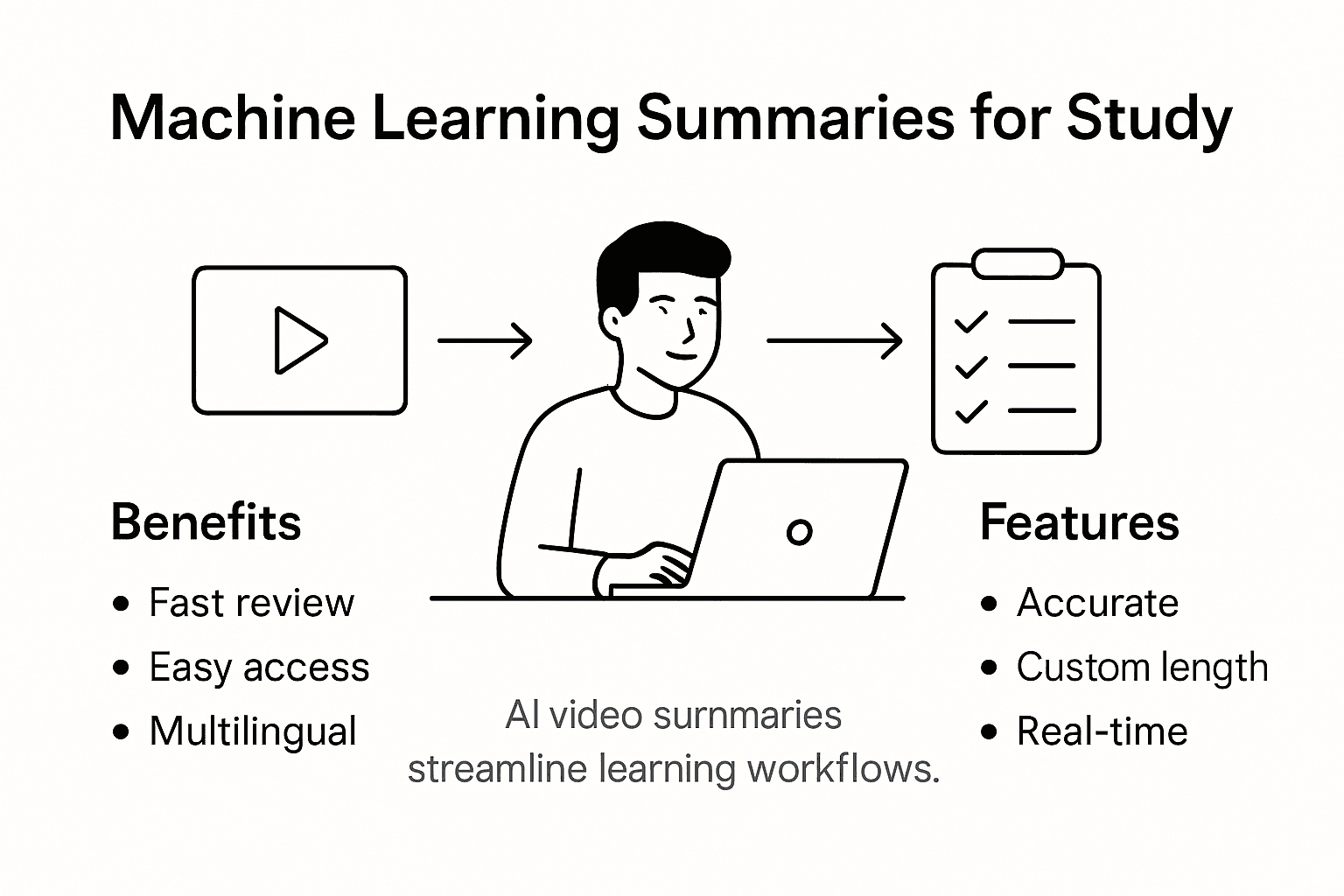
The practical applications span multiple academic domains, with key benefits including automatic lecture indexing, rapid literature review support, and enhanced accessibility for diverse learning needs. Lecture comprehension becomes significantly more efficient as these technologies can extract key concepts, track thematic progression, and generate concise summaries that capture complex information in digestible formats. Researchers can leverage these tools to quickly scan through extensive video archives, identifying relevant research segments, detecting emerging trends, and synthesizing interdisciplinary insights without investing hours in manual review.
Real-time machine learning video summarization offers remarkable accessibility advantages, particularly for students with learning disabilities or those who require alternative content consumption methods. The systems can generate multilingual subtitles, provide semantic context annotations, and create structured notes that complement traditional learning materials. These technologies are especially powerful for graduate students conducting extensive literature reviews, enabling them to process multiple research presentations, conference recordings, and academic webinars with unprecedented speed and accuracy.
Pro tip: Integrate video summarization tools into your academic workflow by creating a systematic approach for capturing and organizing key insights from multimedia research sources.
Practical Challenges and How to Overcome Them
Video summarization technologies face significant technical hurdles that require sophisticated approaches to resolve. Deep learning video summarization challenges highlight complex obstacles including subjective relevance interpretation, computational resource constraints, and the persistent challenge of creating universally meaningful summaries across diverse content domains.
One primary challenge involves maintaining semantic integrity during summary generation. Machine learning models must navigate intricate nuances of content, distinguishing between critical information and peripheral details. Advanced summarization strategies recommend implementing adaptive learning frameworks and sophisticated attention mechanisms that can dynamically adjust summary parameters based on contextual complexity. These techniques help mitigate issues like dataset bias, limited generalizability, and inconsistent output quality that have historically plagued automated summarization systems.
To address computational expenses and processing limitations, researchers are developing hybrid approaches that integrate human feedback and machine learning algorithms. These models create more flexible, context-aware summarization techniques that can adapt to specific domains such as academic research, professional training, or multimedia content. By incorporating user interaction and continuous learning mechanisms, these advanced systems can progressively improve their understanding of relevance, nuance, and information hierarchy across different video types and subjects.
Below is a summary of challenges in video summarization and approaches to address them:
| Challenge | Impact on Summaries | Solutions Recommended |
|---|---|---|
| Semantic integrity | Loss of key details | Adaptive learning models |
| Resource limitation | Slower processing | Hybrid human-machine systems |
| Algorithm bias | Skewed summary content | User feedback integration |
Pro tip: Implement iterative testing and user feedback loops when using video summarization tools to continuously refine and improve summary accuracy for your specific use cases.
Unlock Faster Learning with AI-Powered Video Summaries
The article highlights challenges like semantic integrity, resource constraints, and the need for accurate, context-aware video summaries that help students and researchers quickly grasp key insights from complex video content. If you want to overcome these common pain points and save hours of watching lengthy lectures, webinars, or tutorials, SummYT offers the perfect solution. Our AI-powered platform produces concise, clear summaries that capture essential themes without losing meaning or nuance.

Experience how SummYT transforms your study and research workflow by delivering unlimited, multilingual summaries designed for educational success and professional productivity. Take control of your time and learn more effectively by visiting https://summyt.app to get started. Discover how AI technology from SummYT bridges the gap between complex video content and your need for quick comprehension today.
Frequently Asked Questions
What are machine learning video summaries?
Machine learning video summaries are advanced computational techniques that transform video content into concise, meaningful representations using algorithms, without manual human intervention.
How do extractive and abstractive video summarization techniques differ?
Extractive techniques select key segments from the original video to create a highlight reel, while abstractive techniques generate entirely new summaries that rephrase or reinterpret the original content.
What are some practical applications of video summarization for students and researchers?
Video summarization technologies assist in automatic lecture indexing, rapid literature review support, and provide enhanced accessibility for diverse learning needs, making complex information easier to process.
What challenges do video summarization technologies face?
Key challenges include maintaining semantic integrity during summary generation, managing resource limitations, and addressing algorithm biases, which can result in skewed or inaccurate summaries.